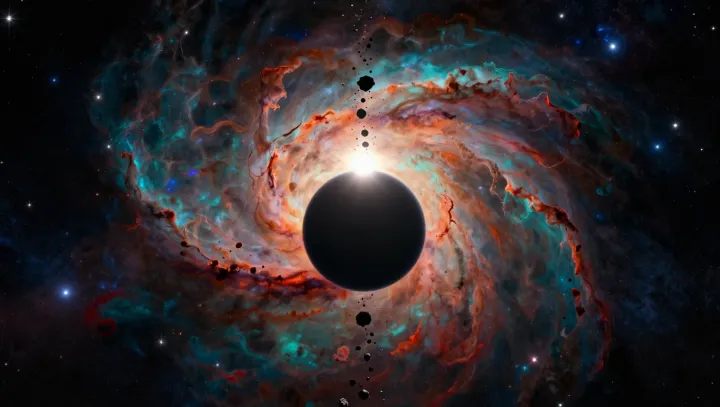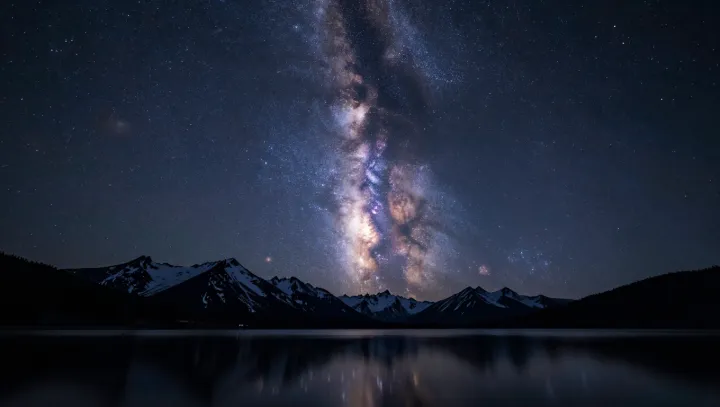
The observable universe is only a finite bubble in a potentially infinite cosmic landscape. Its commonly quoted size, on the order of tens of billions of light-years, does not describe all of space, only the region from which light has had time to reach Earth since cosmic expansion began.
Two constraints set this horizon: the finite speed of light and the finite age of cosmic expansion. General relativity describes space-time as dynamic, so while photons travel at light speed, the fabric of space itself stretches in between galaxies. This expansion, governed by the Friedmann equations and influenced by dark energy, means distant regions recede faster than light without violating special relativity.
Because space expands, the most distant galaxies we can see today were much closer when they emitted the light we now detect. Their light has been in transit through an expanding metric, so the current distance to those galaxies is far larger than the light-travel distance alone. Beyond that observable sphere, space can simply continue with the same large-scale properties, without any boundary or edge, in the way a mathematical plane has no outer wall even though any observer on it can access only a limited patch.