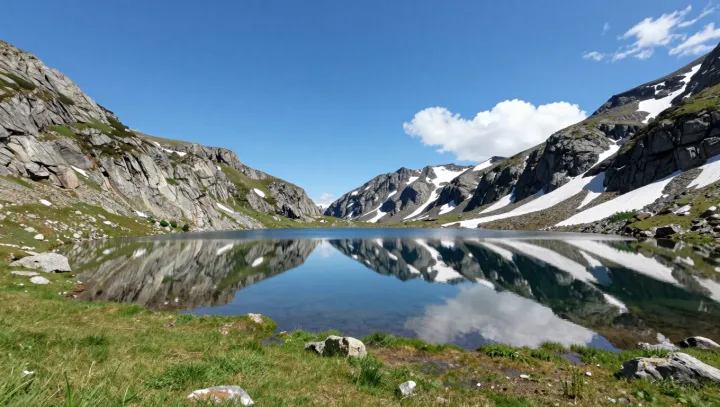
Water in glacier-fed lakes behaves less like a mirror and more like a precision optical filter. The unreal turquoise seen in places such as Moraine Lake and Lake Tekapo comes from rock flour, the fine sediment created when moving ice grinds bedrock into microscopic particles.
These particles remain suspended in meltwater because of their tiny grain size and low settling velocity, forming a dense colloid rather than a clear solution. Under solar radiation, they trigger selective scattering, a process described by Mie scattering rather than simple reflection. Longer wavelengths in the red and yellow range are scattered and absorbed differently from shorter blue-green wavelengths, shifting the apparent color of the water toward that intense turquoise band.
The underlying liquid water still shows Rayleigh scattering, but the optical budget of the lake is dominated by this concentrated load of suspended sediment. Hydrologists track the mass flux of rock flour as a proxy for glacier erosion rates, while limnologists treat the particles as a key parameter in lake optical depth and albedo. The result is a natural display that looks like post-production color grading but is in fact a direct readout of glacier mechanics and sediment transport physics.