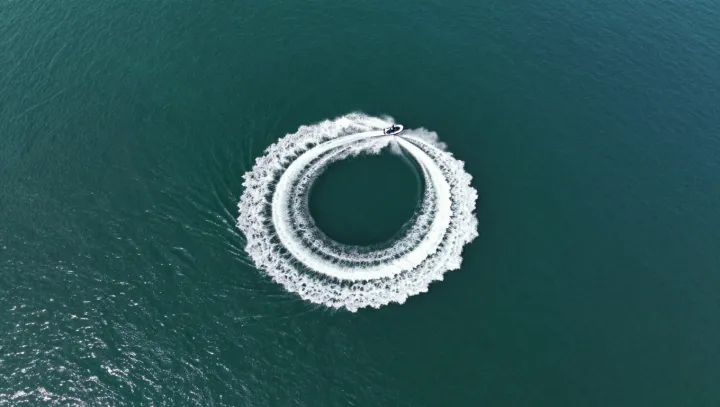
A churning boat wake looks hostile, yet for elite wakeboarders it becomes a controlled launch system. The apparent chaos hides a repeatable pattern of wave height, face angle and timing that riders learn to read and then deliberately reprogram with speed and line choice.
The core physics is simple but unforgiving. By edging out wide, riders create a long, arcing path that builds centripetal force and line tension, similar to a pendulum under constant gravitational acceleration. This stored kinetic energy is released as they cut back toward the boat, meeting the wake at a specific edge angle so the water’s reaction force redirects momentum upward, not sideways. Hydrodynamic pressure on the board’s base, combined with a stiff, low‑stretch rope, turns the foaming crest into a predictable “water ramp” with a known takeoff vector.
Safety gains come from managing deceleration, not avoiding height. A higher trajectory over a longer flight spreads impact over time, reducing peak ground reaction force when the board reconnects with the surface. Riders fine‑tune rope length to sync their apex with the wake’s cleanest section, trimming turbulence that could cause unpredictable rotational torque. Progressive edging, controlled angular velocity in spins and flips, and precise spotting of the landing zone convert what looks like risk escalation into a reduction of mechanical load on joints and spine.