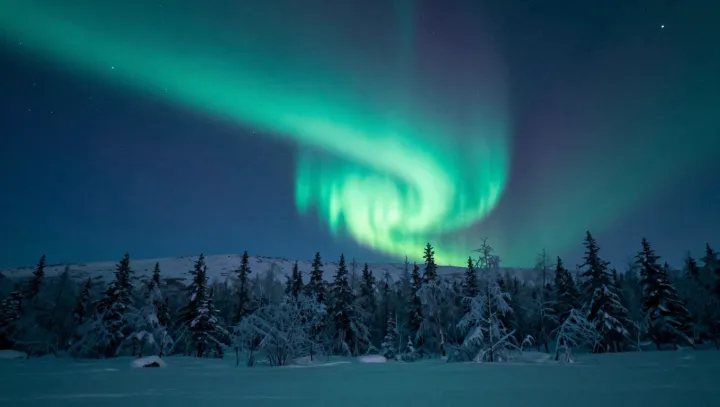
Tiny Yellowknife outperforms many communities nearer Earth’s magnetic pole as an aurora destination, offering roughly 240 nights of visibility in a typical year. Geography, not romance, explains the gap: the town sits almost perfectly within the auroral oval, the doughnut-shaped ring of near-constant geomagnetic activity that encircles the planet.
The auroral oval, defined by magnetic latitude rather than ordinary geographic latitude, tends to park itself over Yellowknife’s region for long stretches. Charged particles guided by the magnetosphere collide with atoms in the upper thermosphere there with remarkable consistency, so the basic energy input is reliable. Many locations deeper inside the Arctic Circle actually sit closer to the geomagnetic pole, where the oval thins and shifts, reducing the probability that overhead sky will light up on any given night.
What happens above the clouds matters little if clouds win. Yellowknife’s continental, subarctic climate delivers long runs of clear, dry nights with relatively low water vapour, cutting down on scattering and absorption. Coastal Arctic sites face frequent low-pressure systems, sea-ice fog and persistent cloud cover that erase many potential displays. Add sparse light pollution and a flat, unobstructed horizon, and Yellowknife converts geomagnetic activity into visible aurora with unusual efficiency, turning a global atmospheric process into a remarkably dependable local spectacle.