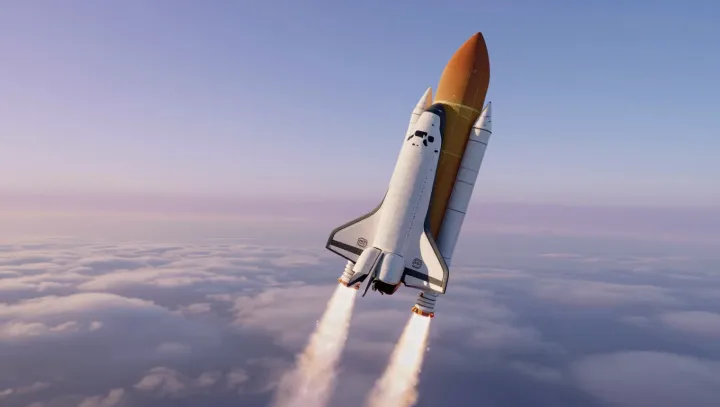
A rocket plume can curl across the sky like a dragon while still obeying strict equations. As exhaust leaves the nozzle, hot gases expand into the thin upper atmosphere, forming a high‑speed jet that quickly becomes turbulent. Instabilities break the flow into eddies and filaments, a textbook case of turbulence and vortex shedding rather than a random sketch.
Those twisting shapes emerge as the supersonic exhaust mixes with surrounding air and water vapor condenses in low‑pressure regions, making otherwise invisible structures visible. The overall outline can resemble a head, body and tail because coherent vortices link together along the plume, guided by conservation of momentum and the Navier–Stokes equations that govern fluid motion.
The luminous, almost biological glow is set by optics, not fantasy. When the rocket flies in darkness while its plume sits in sunlight, tiny droplets and ice crystals scatter light through Rayleigh scattering and Mie scattering, turning the sky into a backlit canvas. To an observer on the ground, deterministic fluid dynamics and radiative transfer simply project as a dragon-shaped cloud of light.