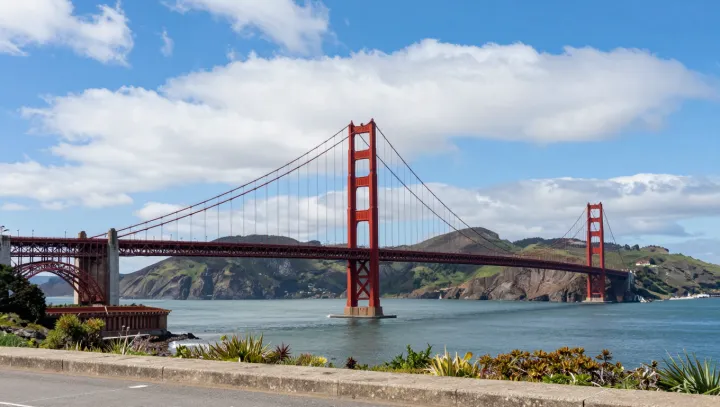
Flexibility, not brute strength, is the Golden Gate Bridge’s quiet trick. The roadway hangs from main cables like a long, controlled catenary, so loads travel as tension in steel wire rather than as brittle bending in concrete or stone. That geometry lets the deck shift sideways and vertically by meters while the towers and anchorages channel forces into the ground through compression and massive gravity blocks.
Equally counterintuitive is how much motion is baked into the details. Thermal expansion is handled by expansion joints and rocker bearings that slide or rotate, so the steel deck can lengthen and shorten instead of building up internal stress. Wind is treated as a fluid mechanics problem: the slender, truss‑stiffened deck and open railing break up air flow to reduce vortex shedding and aerodynamic instability, limiting oscillations before they grow dangerous.
What really keeps the structure from cracking is controlled ductility. High‑strength steel cables carry enormous tensile stress while still allowing elastic deformation, and the towers act as tall, flexible frames rather than rigid walls. Every hanger, riveted connection, and gusset plate was sized so that under service loads the steel stays in the elastic range, turning the entire 1.7‑mile span into a vast spring instead of a rigid bar waiting to snap.