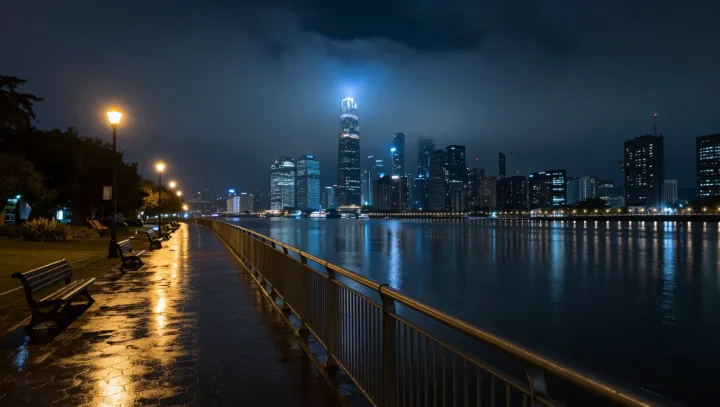
Glass and steel along the harbor now behave less like offices than like camera rigs, their LED grids and reflective skins tuned for the lens as much as for the balance sheet. What began as a corridor for clearing trades and containers has been rewired into a broadcast surface, with fiber trunks, edge data centers and rooftop antenna farms stitched into almost every riverfront block.
The oddity is that the spectacle rides on infrastructure built for something else entirely. Co-location hubs near the exchanges, once optimized for low-latency order routing and disaster recovery, now offer broadcast control rooms dark fiber, redundant power and carrier-neutral meet-me rooms that can push uncompressed video feeds across continents. Stadium planners and rights holders are not just renting sightlines; they are effectively leasing access to a preexisting mesh of optical backbones and microwave links that traders forced into the ground and sky years ago.
Equally underappreciated is how zoning and tax credits nudged this shift without naming it. Incentives that lured back-office towers and logistics terminals to the water also concentrated rooftops suitable for 5G small cells, satellite uplinks and millimeter-wave relays, turning the skyline into a dense broadcast lattice just as global streaming demand exploded. As the tournament cameras pan across the harbor, what looks like a familiar postcard is in fact a live diagram of how finance-era connectivity quietly subsidized the world’s newest mass spectacle.