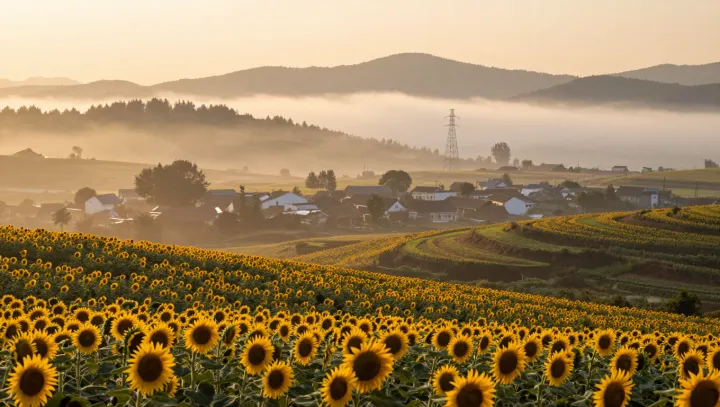
That floating village is not magical at all; it is a small failure of common sense about how air should behave. Warm air, less dense, usually rises, yet under a temperature inversion a shallow layer of cold, heavy air hugs the valley floor while a warmer layer sits above, like a lid that refuses to budge.
Most mornings that look otherworldly begin with something very ordinary: nocturnal radiation cooling from bare soil and river surfaces. As ground releases stored heat, the air just above it cools rapidly, reaches dew point, and condenses into tiny droplets, building advection fog that crawls along gullies and basins. Because cold air is denser, gravity quietly sorts the atmosphere, letting chilled, saturated air drain downslope into low pockets while ridges stay perched in warmer, drier air. So the village on the shoulder of the hill, and those sunflower fields just high enough to clear the lid, sit in direct sunlight while the valley becomes a glowing diffuser panel, scattering light back upward.
The real surprise is how stubborn this structure is. With only weak wind shear and limited vertical mixing, the inversion layer resists disruption, so the cloud ocean holds its sharp upper surface like poured milk. To eyes trained on simple “warm rises, cold sinks” rules, the scene looks impossible, yet it is textbook stratification made visible, a quiet diagram drawn in light and fog.