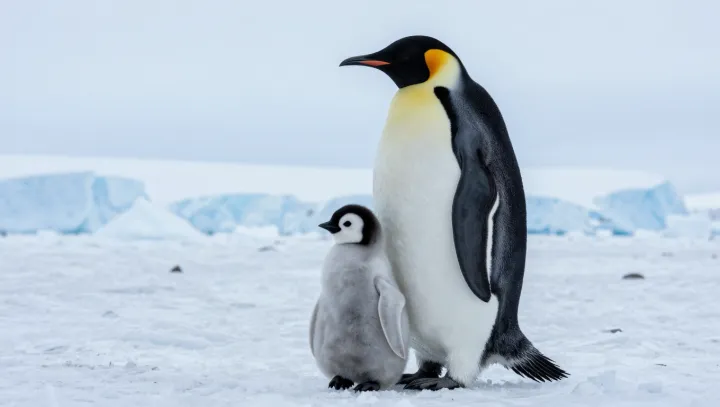
An egg on bare ice would die in minutes; that is the blunt logic driving the emperor penguin father’s ordeal. In Antarctic winter, air near the colony can fall far below freezing, and wind strips heat from any exposed surface at a rate that would freeze unprotected tissue faster than most small animals can generate metabolic replacement. The only stable incubator available is the male’s body, specifically a dense brood pouch of skin and feathers over his feet, which can keep the egg near optimal temperature while the environment rages around it in lethal cold.
This sacrifice is not sentimental; it is a calculated trade in evolutionary terms. The species produces a single large egg, and the male’s prolonged fast is the price of that high-value investment, enforced by the physics of heat transfer and the biology of fat reserves. His subcutaneous fat layer works as insulation and energy bank, allowing basal metabolic rate to fall while still powering continuous shivering thermogenesis and maintaining core temperature. Huddling behavior then acts as a living heat shield, cutting convective heat loss, so that the group’s combined thermal mass buys just enough time for the female to feed at sea and return with stored energy for the chick.
The weight loss that can reach about half the body’s starting mass is therefore not a failure of survival but its mechanism. By converting fat into heat with high efficiency, the male turns his own body into a controlled energy budget that bridges the gap between laying and hatching. If he abandoned the egg to feed, the embryo would chill past its physiological limit and the pair would lose their only offspring of the season. Endure hunger and the genes move forward; walk away to eat and the breeding effort ends in silence.