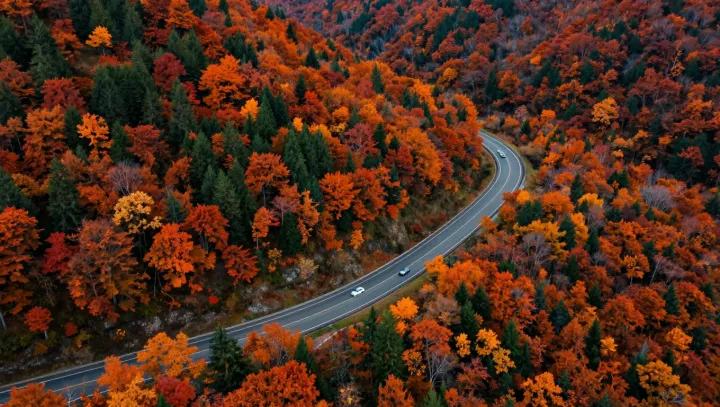
A thin road can act less like a path and more like a border. On either side of the asphalt, researchers measure different air humidity, soil moisture, and light, a set of edge effects that begins within a few meters of the pavement and can extend deep into the canopy.
The harsh claim from field biologists is simple. A forest split by traffic is no longer one habitat but two, separated by what behaves as a semi-permeable membrane. Heat radiating from dark asphalt, altered albedo, and turbulent air from passing vehicles shift microclimate conditions, changing evapotranspiration patterns and nudging local temperature baselines apart even under the same sky.
More striking is how animals treat this line. Many small mammals and amphibians avoid crossing because of vehicle mortality risk and exposure to predators on open ground, so their home ranges compress against the verge. That behavioral barrier reshapes dispersal routes, concentrates roadkill at narrow crossing points, and leaves tracking studies with mirror-image movement networks on each side.
Most unsettling is what happens in plant genetics. Pollinator insects and seed-dispersing birds hesitate to cross busy lanes, throttling gene flow between stands of the same species. Over time, population genetic structure diverges, with measurable shifts in allele frequencies and reduced heterozygosity on one side, all triggered by a single strip of engineered stone cutting through autumn leaves.