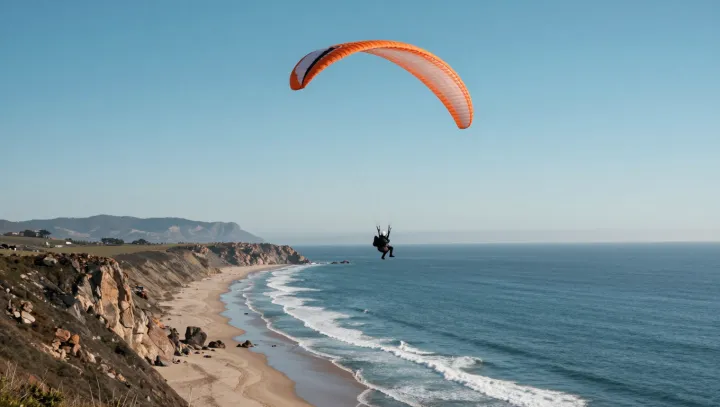
Chaos, in Chen Yang’s version of coastal wind, is not mystery but missing data. Foam lines on the water move first, long before a wing loads up, and that visual lag became his starting variable rather than a piece of folklore to ignore.
His core bet is blunt. Gusts only feel random because athletes and even fishermen sample them too slowly, so he flooded the problem with measurement. A shore-to-buoy strip of low-cost ultrasonic anemometers, barometric pressure nodes, and high-frame-rate video turned a short landing corridor into what amounts to an open-air wind tunnel, feeding raw vectors into a time-synced database.
The real shift comes from how he treats that stream. Instead of chasing a single perfect forecast, Yang uses Bayesian inference and Monte Carlo simulation to generate probability fields for lift and sink over each square of approach airspace, then collapses them into a simple three-color glide path that pilots can read in a glance. Punchy interface. Heavy math underneath.
More radical is his insistence that muscle memory must be version-controlled. Each landing logs angle of attack, sink rate, and flare timing through inertial measurement units and GNSS, then gets auto-scored against the model’s predicted safe envelope, creating a closed-loop between atmosphere, athlete, and algorithm that looks less like a gravity sport and more like incremental engineering.
To skeptics who say wind will always win, his answer is unsentimental: increase sampling frequency, tighten error bounds, and treat every approach as another data point, not a stunt.