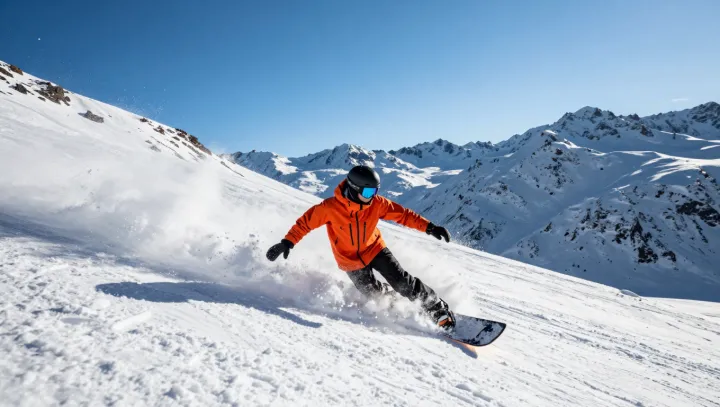
An easy powder run can betray a rider by morning. A minor rise above the freezing point, then a slide back below it, quietly rewrites the entire top layer of the snowpack. Liquid water forms at grain contacts, breaks the delicate dendritic branches, and then locks them together again as a dense crust when the surface temperature drops. What felt like compliant, low-density powder now behaves as a stiff sheet with far higher shear strength and almost no give under the board.
That new surface demands a different kind of honesty from a snowboard. Gentle skids that worked in powder now fail because the reduced coefficient of friction and higher elastic modulus of the refrozen layer push the board to accelerate and chatter. To hold a line, the rider must increase edge pressure, commit to cleaner carve angles, and adjust timing to engage the sidecut earlier, since micro-bumps transmit directly through the board instead of being damped by soft grains.
The psychological trap is that the slope and the board appear unchanged. Only the near-surface thermal profile and grain morphology have shifted, from open, rounded crystals to compacted, refrozen plates. Where the board once floated and brushed through a deformable medium, it now rides on a thin, unforgiving interface, turning yesterday’s playful descent into a test of edge precision and line discipline.