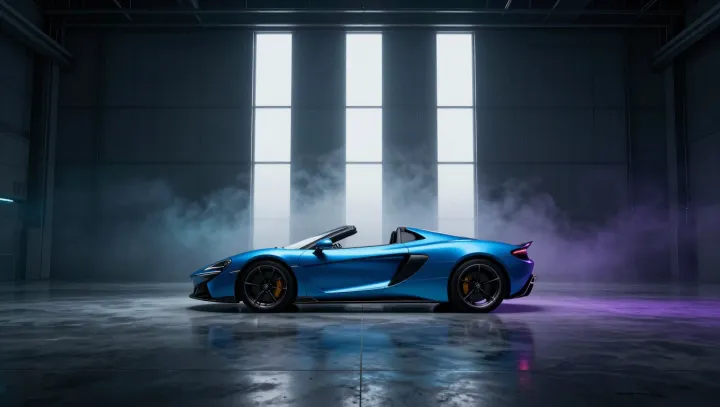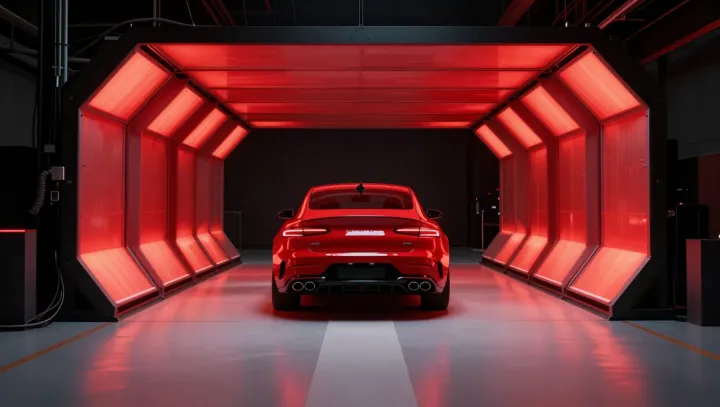
Valencia Red Pearl does something paint should not do: it fakes inner light. Under flat daylight, the NSX body seems backlit, as if a power source sits under the aluminum skin and not in the engine bay.
At the core is a bias toward optics, not color swatches. Acura builds the hue as a multi-layer coating system: a primer that controls surface smoothness, a highly reflective metallic base, a translucent red mid-coat loaded with interference pigments, then a clear coat that locks the stack. Those interference pigments and aluminum flakes manipulate incident light through controlled reflection, refraction and partial absorption, turning the panel into a shallow light well rather than a simple colored shield.
What looks like glow is really managed scattering. Light enters through the clear coat, bounces off the metallic base, then passes back through the tinted mid-layer, where selective wavelength attenuation and micro-scale Mie scattering enrich the red while leaving highlights almost white. Because the layers are transparent and optically active instead of opaque, the visual effect stays alive even when the sun goes dull. The car does not get brighter; the paint simply refuses to go flat.