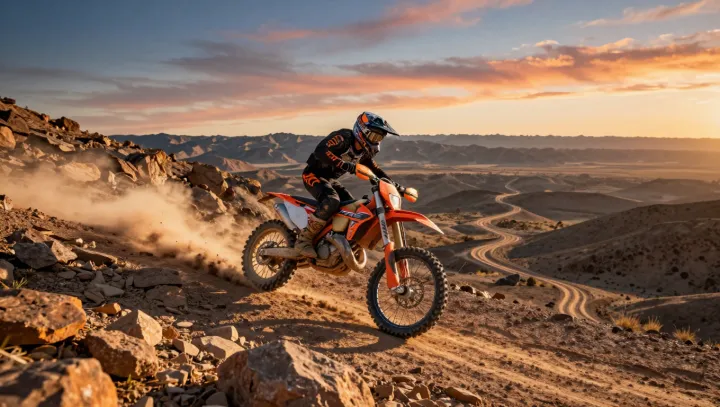
Brutal terrain rewards the rider who gives up fake control. On rock‑strewn desert lines, a death grip locks the upper body, turns elbows and shoulders into rigid struts, and forces the front wheel to deflect off every impact instead of tracking through it.
More authority comes from acting like extra suspension. With a relaxed grip and taller stance, the rider’s ankles, knees, and hips move in flexion‑extension, working in series with the fork and shock rather than against them, which lengthens the effective travel and keeps tire contact patches loaded instead of skipping. When the torso floats above the pegs, the bike’s center of mass can shift independently under the rider, so sudden lateral hits get absorbed as relative motion between chassis and body rather than as a full‑system tip‑over.
Fewer mistakes start in the brain, not the throttle hand. A clenched posture spikes co‑contraction of opposing muscle groups, burns oxygen, and degrades proprioception and vestibular feedback, so small balance errors arrive late and overcorrected. Relaxed hands free up fine motor control at the fingers, letting riders modulate front brake and clutch with millimeter precision while the larger muscle chains in the legs handle gross shock absorption. Standing taller also widens the field of view, buys extra fractions of a second for line choice, and turns what looks like chaos into a series of readable patterns under a calmly moving rider.