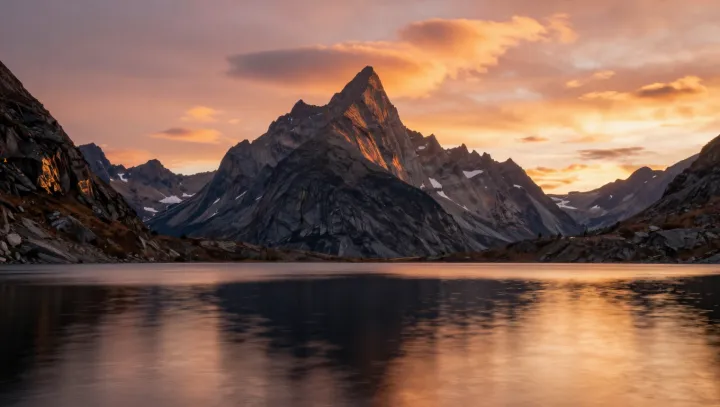
Those gray-sky “mountain fires” are less romance than geometry. At low Sun angles, light travels through a long, dense column of air near the horizon, while the air above the peaks offers a shorter, less selective path. So the sky can stay flat and dull even as the ridgeline burns with color.
The key mismatch is spectral. Rayleigh scattering strips out shorter wavelengths along the slanted path, leaving a surplus of red and orange photons sliding sideways through the thickest atmospheric slice. Mie scattering on aerosols and sea salt then redirects part of that reddened beam downward, so rock faces and water catch a concentrated wash of warm light that the high, gray cloud deck never receives in the same way.
What looks like fire is really contrast engineering by physics. The illuminated slopes sit under this low, filtered beam, gaining saturated reds because their incoming light has passed a longer optical path length and harsher wavelength-selective filtering. The cloud shield overhead, lit mostly by more diffuse, less reddened radiation, reflects a colder spectrum and reads as plain gray. Between those two lighting regimes, the eye invents drama.