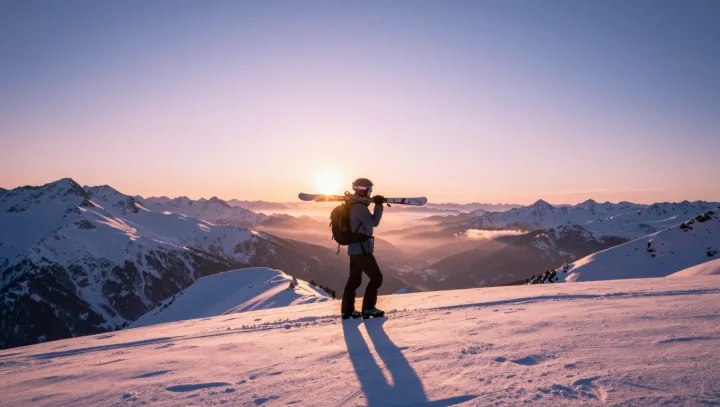
Balance on a knife-edge ridge is less about courage than geometry. Along that icy crest, stability emerges only when the skier’s center of mass sits exactly above the narrow contact line where sharpened steel edges press into granular snow, turning a terrifying drop into a solvable alignment problem.
Most skiers wobble because their body mass drifts a few centimeters to one side, and with it comes torque: the offset between the center of mass and the support line creates a rotational moment that the ankles and hips cannot cancel in time. The stable skier makes microscopic fore-aft and lateral shifts, continuously steering the center of mass back above the base of support so that the net torque around the ridge edge stays near zero.
What looks like poise is really friction management. At the ski edge, normal force and the coefficient of friction set a hard limit on how much sideways shear the snow can resist before sliding begins. By keeping the center of mass stacked directly over that line, the calm skier reduces lateral shear, keeps the frictional force vector aligned with gravity’s pull, and turns a hairline of contact into a reliable platform while others fight the physics they barely notice.