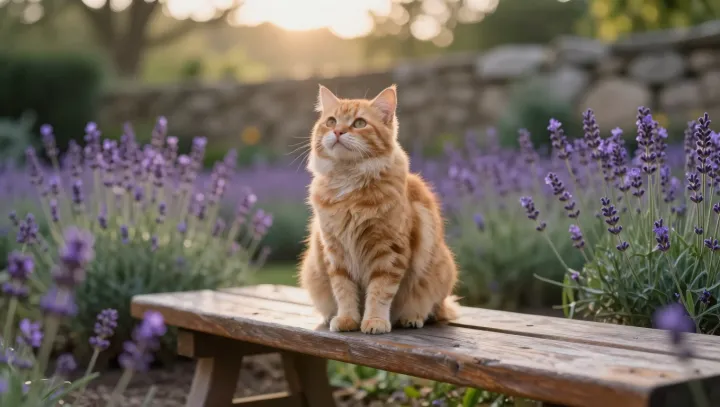
That upward stare is not cute. It is surveillance. From a garden bench, a cat holds its head still while its eyes sweep a zone far larger than the narrow cone you rely on, exploiting a horizontal field of view that can reach well beyond half a circle around its skull.
Predator first, pet second. Behind that fixed gaze sits a retina packed with rod photoreceptors, tuned for low light and motion rather than fine color, and wired through the superior colliculus to trigger rapid orienting responses when a moth twitches or a leaf shifts in a pattern that does not match the breeze.
Your attention is stingy. You lock on to one object; your cat runs parallel processes. While its central fovea lags behind yours in sharp detail, its peripheral vision and motion parallax detection create a live contour map of the airspace above hedges and fences, flagging anomalies long before any conscious decision is needed.
Complacency is a human bias. In outdoor settings, felines still behave as if raptors or rival carnivores might appear overhead, so their visual system treats every small angular change as potential signal, feeding constant data into fast-twitch neck muscles and a nervous system primed to sprint, climb, or freeze without negotiation.