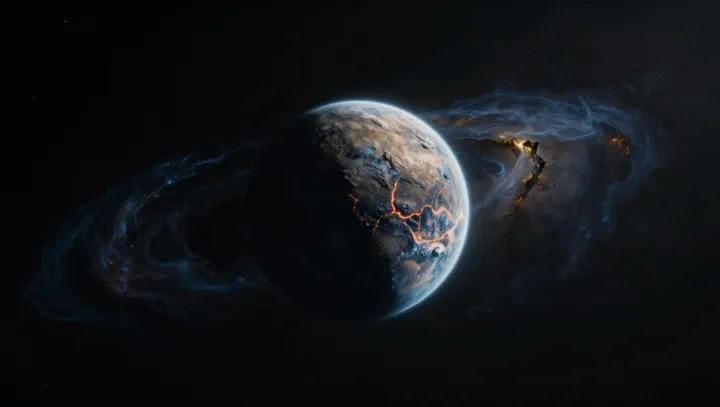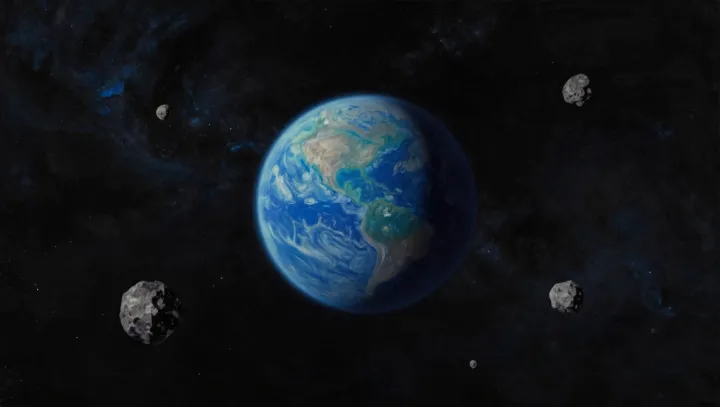
Earth looks breakable. The physics says otherwise. A small rocky sphere with a thin gas shell should be easy prey in a sky filled with debris, yet orbital mechanics and mass distribution stack the odds in its favor, turning apparent fragility into quiet resilience.
Gravity does most of the hidden work. The specific architecture of the solar system, with Jupiter’s large gravitational cross‑section acting as a partial sink for incoming bodies, deflects or captures many would‑be impactors before they ever reach Earth’s orbital neighborhood, while resonances sculpt asteroid belts so that only a minority of objects are placed on Earth‑crossing paths.
Protection then becomes layered. Earth’s own gravity focuses some threats but also clears space over long dynamical timescales, the Moon absorbs a share of the hits, and the atmosphere converts many smaller intruders into harmless meteors through shock heating and ablation, so that only a tiny fraction of the original swarm survives to strike continental crust or ocean basins with planet‑scale energy.
Survival is not perfect; it is statistical. Impact craters record repeated catastrophes, yet plate tectonics and erosion recycle the surface, the hydrologic cycle and carbon cycle buffer climate after many blows, and biological evolution repopulates emptied niches, leaving a world that looks delicate but behaves, over cosmic spans, like a system designed to absorb punishment.