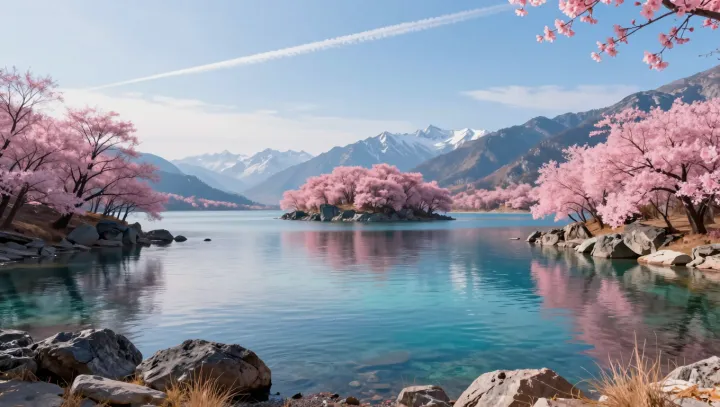
Pink water is an optical trick, not a botanical one. Over high valleys, sunlight first loses part of its blue content through Rayleigh scattering in the upper air, then passes through longer slant paths near the horizon that favor transmission of red and orange wavelengths before touching rock and water.
Those forests that seem blush‑tinted are mostly neutral in pigment; what shifts is the spectrum of light striking their needles and trunks, and then bouncing toward the lake at low angles where Fresnel reflection makes the water surface act like a tilted mirror with selective efficiency for different wavelengths and viewing directions.
The soft, pastel look owes more to physics than to romance. Fine aerosols and ice crystals produce Mie scattering that smears reds and violets into a muted gradient, while suspended glacial flour in the lake body absorbs and diffuses shorter wavelengths, flattening contrast so any residual warm light spreads across the reflection like a wash.
What looks uncanny is actually consistent. Shift your position by a few steps and the hue can fade, because the apparent color hinges on the interaction between incident angle, polarization, surface roughness from ripples, and the human eye’s greater sensitivity to slight changes in red and green under low illumination.