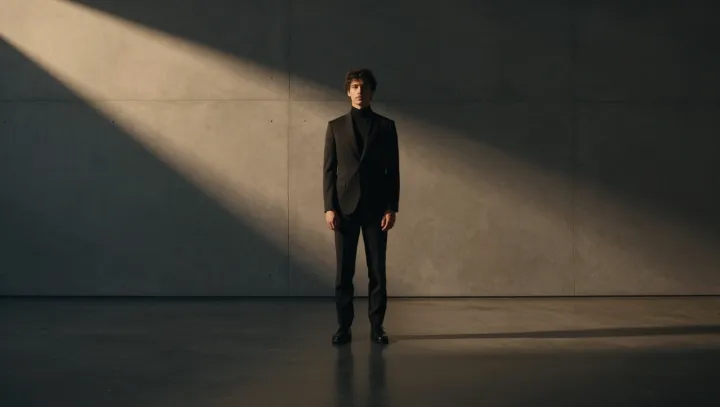
One dark suit with a black turtleneck broadcasts more authority than a jewelry box on legs. The look compresses every signal into one clear message, while layered accessories split attention across competing cues and weaken the perceived center of power.
Power, not decoration, is what the eye searches for first. A single dark value from neck to shoe creates a continuous silhouette that enlarges the figure on camera and in a boardroom, a trick well documented in visual perception research on figure–ground contrast and contour integration. Break that line with bright watches, patterned ties, and busy pocket squares, and the body becomes a display rack instead of a command post. Viewers unconsciously read unity as control, and control as competence.
Intelligence is signaled by restraint long before a word is spoken. Cognitive load theory explains why: every extra bracelet or logo consumes a slice of the observer’s working memory, leaving less bandwidth for processing facial micro‑expressions, argument structure, and status cues like posture. The dark suit and turtleneck act like a user interface stripped of pop‑ups: nothing distracts from the face, the voice, the decision. Accessories can show wealth. Minimalism often shows that the wearer no longer needs to prove it.