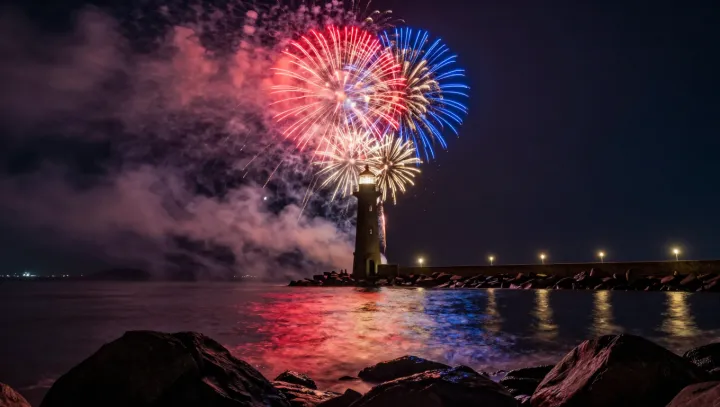
Nothing about those perfect rings around a lighthouse is accidental. Each effect is pre‑plotted in polar coordinates, then translated into ignition times spaced by only a few milliseconds, so shells burst at defined angles instead of drifting into a messy spray.
The bold claim is that a fireworks show is closer to coded choreography than to celebration. Launch racks sit mapped like pixels; firing systems use microcontroller logic and electronic matches to trigger charges on a timing grid tight enough that a three‑millisecond error can smear a ring into an oval. Engineers model projectile velocity, air drag and fuse burn rate, then offset firing times so bursts curve around the lighthouse silhouette while avoiding direct glare on the lantern glass.
Color, oddly, is the most constrained part. To paint a steady red halo, designers rely on strontium salts whose emission spectra lock the hue, then tune fuel‑to‑oxidizer ratios in the combustion plume to keep the temperature within the narrow band where that red stays vivid. For blue waterfalls, copper compounds carry the load, but copper emission collapses if the flame runs too hot, so metal particle size, chlorine donors and binder composition are adjusted to cool the reaction front without killing brightness.
The sharpest trick is that geometry and chemistry must cooperate. Comet stars packed with strontium or copper are arranged in concentric rings inside a shell; when the bursting charge detonates, radial inertia throws those stars outward at near‑identical speeds, while the control system has already placed the shell at the exact altitude and azimuth dictated by its timing code. Where the public sees a halo hugging the lighthouse and a curtain of falling blue, the engineer sees solved equations in ballistics and emission spectra.