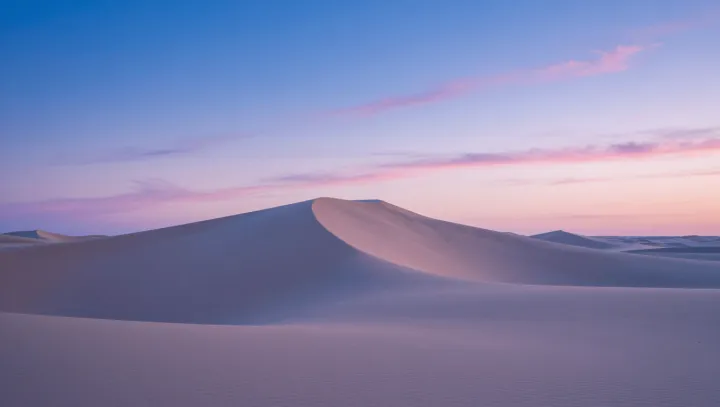
A moving dune looks like a contradiction. Sand should sit where it falls, yet a bare ridge of grains can slide across open desert, displacing tracks, roads, even buried markers. Wind is the only engine here, guided by sunlight that sets daily heating cycles and pressure differences across the ground.
Most of the work happens in a process far less dramatic than it sounds. Individual grains enter saltation, that textbook leap in which wind shear lifts them a few centimeters, they arc forward, then smash into the surface and eject new grains. This chain reaction, known as aeolian transport, shuttles sand up the dune’s gentle stoss slope, grain by grain, in a slow conveyor that never quite shuts off while air keeps moving.
Still more counterintuitive is what actually migrates. The dune’s shape, not its matter, travels. As grains reach the crest, they lose wind support and tumble down the steep slip face in miniature avalanches governed by the angle of repose and dry granular flow. That steady loss on the lee side, matched by supply from upwind, lets the whole form advance like a solid wave, its internal particles constantly replaced yet its profile preserved.
Sunlight is not just scenery here. By heating one side of the desert more than another, it helps set up pressure gradients that steer prevailing winds and modulate boundary layer turbulence, which in turn controls friction velocity at the surface. On clear, calm-seeming days, that invisible physics still nudges grains into motion, so the dune inches forward while the desert appears almost still.