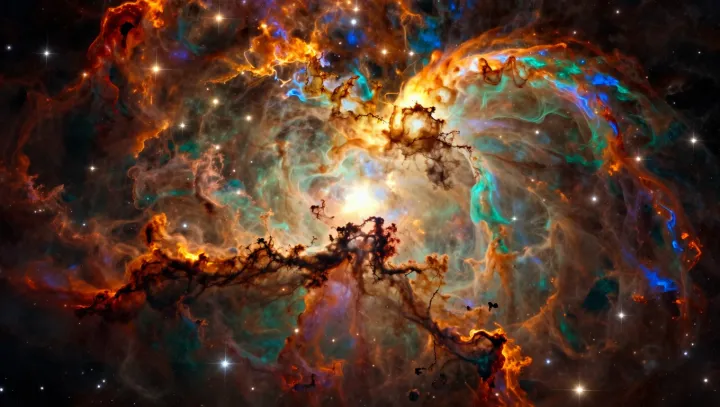
Violence, not gentleness, is what makes a nebula visually interesting. Around massive newborn stars, ultraviolet radiation and stellar winds do not simply clear space; they excavate it, driving ionization fronts and shock waves through the surrounding molecular cloud and setting up sharp boundaries between hot plasma and cold gas.
The oddity is that destruction becomes design. As ionizing photons strip electrons from hydrogen, they create H II regions whose expanding shells act like snowplows, compressing denser clumps of gas into narrow ridges that later appear as filaments. Stellar winds, loaded with momentum and sometimes collimated into jets, punch cavities in the cloud; at the edges of those cavities, Rayleigh–Taylor and Kelvin–Helmholtz instabilities wrinkle the gas into threadlike structures that trace pressure gradients and density contrasts too subtle to see otherwise.
Even the light is a by-product of this assault. Gas at the ionization front, heated to thousands of degrees, cools by emitting specific spectral lines, such as hydrogen alpha and forbidden transitions of oxygen and sulfur that pick out the filaments in red and teal. Dust grains in the compressed lanes scatter and reprocess starlight, contouring the glow. From far away, the scene looks delicate, almost fragile; up close, it is a battlefield where radiation pressure, photoevaporation, and hydrodynamic turbulence turn raw chaos into visible structure.