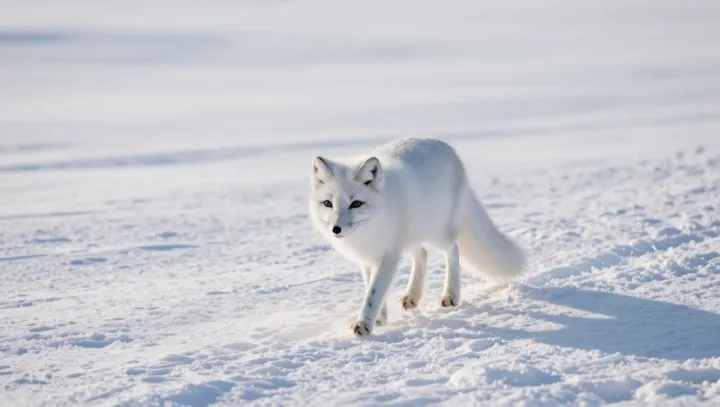
White fur is a lie of sorts. Against subzero snow, an Arctic fox looks like a ghost on infrared, its body heat barely bleeding into the air while its core stays warm enough for sprinting, hunting, breeding.
The real engine is hidden. Beneath that pale coat sits dark, melanin-rich skin that behaves like a passive solar panel, absorbing shortwave radiation even when the sun hangs low and weak, then feeding that energy into dense peripheral tissues and a compact torso built to minimize surface area. On top, the fur acts less like clothing and more like vacuum flask insulation: hollow guard hairs trap air; a thick underfur layer cuts convective heat loss; and the low thermal conductivity of keratin turns each hair into a barrier that resists conduction from skin to snow.
The result is counterintuitive. The fox runs hot inside, yet cameras tuned to longwave emission see almost nothing, because the temperature gradient is forced to collapse within the fur instead of at the outer surface. That same structure disrupts radiative transfer: few photons in the thermal infrared range escape, so emissivity at the coat boundary stays close to ambient. Add countercurrent heat exchange in the limbs, and extremities dump minimal energy into the drifts. To a predator or researcher relying on infrared, the Arctic fox is not just camouflaged in color. It is camouflaged in heat.