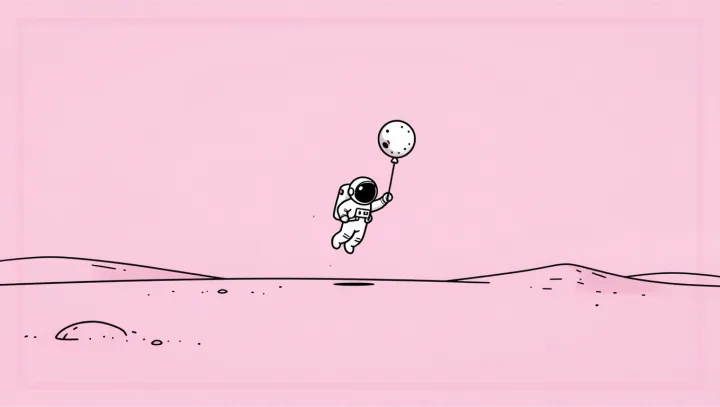
That pink-sky balloon fantasy collapses the moment hard physics walks in. Real Moon gravity is about one sixth of Earth’s, yet a balloon the size and mass of the Moon gives you almost nothing to work with, because buoyancy depends on displaced fluid, not on visual drama.
The harsh claim is this: keep the Moon’s mass and radius, and no breathable atmosphere can float a person on a Moon balloon. Archimedes’ principle and the ideal gas law say the upward force equals the weight of the displaced gas; with lunar gravity fixed, you would need an atmosphere so dense that one cubic meter weighs roughly as much as a person, or a balloon interior at impossibly low density, both regimes far beyond any gas mixture a human could inhale without lethal pressure and temperature.
More radical is the only honest fix. Either gravity must be nearly switched off, or the balloon must shed almost all that lunar mass. Drop surface gravity by several orders of magnitude, and even a thin gas can support a human-scale payload; conversely, keep gravity gentle but compress the Moon’s mass into the same sphere and the surface gravity skyrockets, making buoyant lift even worse. In any realistic gravitational field and air composition compatible with lungs, a Moon-mass, Moon-sized balloon is not a whimsical vehicle but a dead weight, hanging in a sky that has no patience for dream logic.