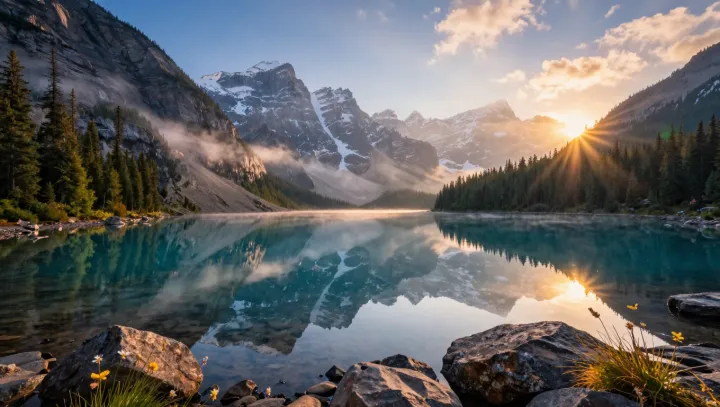
Almost too artificial to trust looks the lake at sunrise, a pane of liquid glass tinted in otherworldly blue. Yet the source is blunt geology. Glaciers grind bedrock into ultra-fine sediment known as rock flour, a suspension of particles so small they hover in the water column rather than sink.
That powder does something radical to light. By Mie scattering and Rayleigh scattering, the grains bounce shorter blue and turquoise wavelengths toward an observer while letting much of the red pass or disperse, so the basin glows as if lit from within. At low solar angles near sunrise, the path of light through the atmosphere is longer, stripping even more reds and oranges before the beam strikes the milky water, which then selectively returns the remaining cool tones.
Equally deceptive is the mirror itself. A lake this still is not calm by accident; dense, near-freezing meltwater suppresses convection and wind shear barely wrinkles the surface, cutting down diffuse reflection. That leaves specular reflection dominant, the same principle exploited by precision optical flats, so mountains and clouds snap into focus on the surface with almost photographic clarity, as if the sky had quietly acquired a second, horizontal copy.