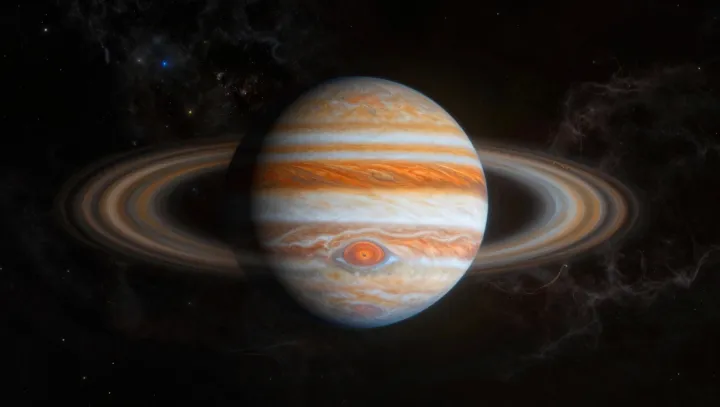
A gas giant is the ideal factory for storms that never seem to end. On such a world, there is no solid surface to sap a vortex of energy, so a storm can roll over endless hydrogen and helium, harvesting heat from below and radiating energy away only slowly through the upper atmosphere.
The key driver is deep convection. Hot material rises from lower atmospheric layers, cools, and sinks again, creating continuous vertical motion that injects kinetic energy into swirling systems. Rapid planetary rotation amplifies this process: the Coriolis force stretches small eddies into organized vortices, while differential rotation between jet streams shears and sharpens their boundaries instead of shredding them completely.
Such a vortex can grow absurdly large. Surrounded by multiple zonal jets, it becomes trapped in a kind of atmospheric cul‑de‑sac, where merging with smaller storms feeds its circulation. The planet’s massive gravity compresses the gas, boosting pressure and temperature at depth, so the vortex can extend far below the visible cloud tops, turning the storm into a towering column of rotating fluid that has the inertia to survive for centuries and once outsize Earth itself.