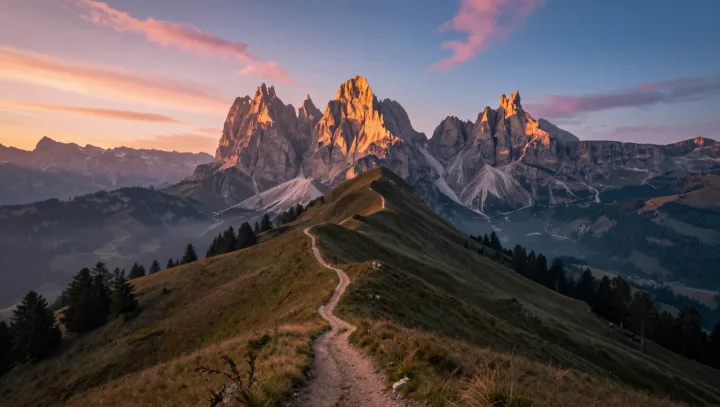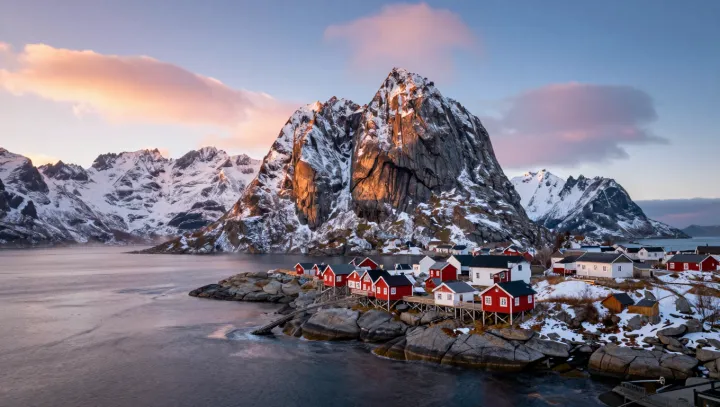
Gold is a trick. A low sun does not enrich the world; it edits it. Near the horizon, sunlight crosses a long column of air, and Rayleigh scattering strips out much of the short blue wavelengths while Mie scattering on larger particles softens what remains, leaving a spectrum biased toward reds and yellows that the eye interprets as warm and metallic.
Rock is no passive victim here. Its silicate surfaces already scatter light diffusely; when the incident angle flattens, micro‑textures cast elongated penumbras, boosting luminance contrast so that even a cold gray cliff acquires a burning edge. Between rock and sun, clear air becomes a selective filter, its optical depth turning a broad white emission into a narrow band that mimics the chromatic signature of actual molten metal more closely than the neutral daylight that dominates at higher solar elevations.
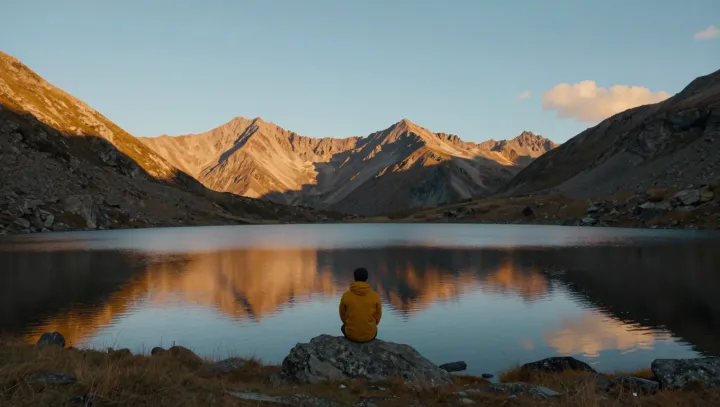
Water cheats most of all. At shallow angles, Fresnel reflection spikes, so a sheet of colorless liquid stops being transparent and turns mirror‑like, throwing back the already reddened solar disk almost intact. Tiny ripples act as moving facets, each obeying Snell’s law yet together smearing the image into a continuous golden field. No extra photons appear; radiative flux stays constant. Geometry, scattering, and human visual processing simply reweight the same light, and for a brief interval the ordinary spectrum looks like alchemy.