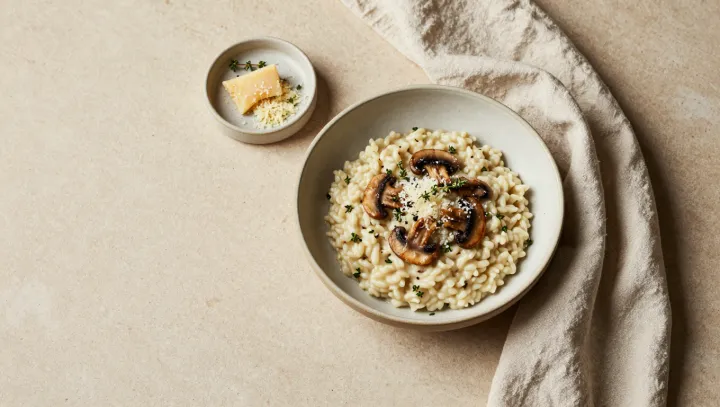
Steam rising from a pot of mushroom risotto often does more metabolic work than an entire family-size snack bag. That is not about romance. It is about how the body scores calories, not how a label counts them.
A slow-cooked risotto is a structural challenge to hunger. Starch granules swell, proteins from stock and cheese integrate, and mushroom fiber thickens the matrix, so gastric emptying slows. The same nominal energy in ultra-processed snacks arrives as fragmented starch, added sugars and isolated fats that the stomach clears faster, giving weaker mechanical stretch and a shorter-lived sense of fullness.
Satiety chemistry also tilts toward the risotto. Real mushrooms and rice demand chewing, which boosts cephalic phase responses and insulin signaling, while intact cell walls and viscous texture stimulate hormones such as GLP-1 and peptide YY along the gut-brain axis. Ultra-processed formulations, engineered for palatability and rapid glycemic response, spike reward circuits without matching signals from leptin or gut peptides, so the brain reads them as hedonic hits, not a finished meal.
There is a final twist. Eating risotto usually happens at a table, with slower bites and clearer sensory feedback, reinforcing homeostatic appetite control. Grazing through a crinkling snack bag encourages mindless intake, short-circuiting those regulatory loops and leaving the same calories feeling strangely unfinished.