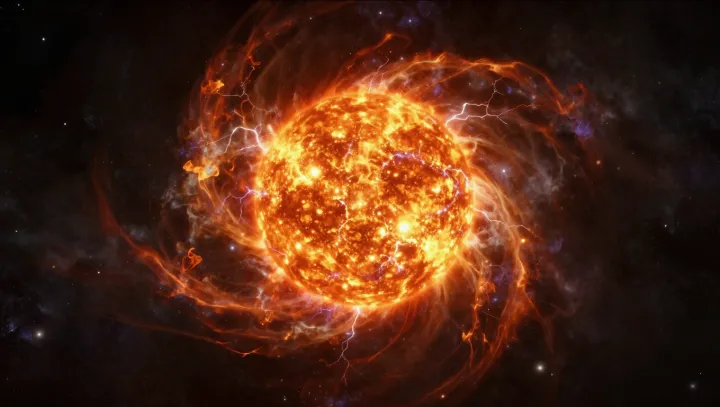
That spotless disk is a lie, at least to the intuition. The Sun is a roiling plasma furnace where hydrogen nuclei fuse into helium and surface gas can hit thousands of degrees, yet distance and physics conspire to flatten chaos into a clean edge. The visible surface, the photosphere, is only a thin shell where photons last scatter out, so telescopes mostly sample a single, smooth optical depth layer rather than the full three-dimensional violence beneath.
The harsher claim is that the Sun only looks solid because our tools are blunt. Angular resolution and point spread functions smear fine detail, so granulation cells larger than continents collapse into subtle mottling, while magnetic flux tubes and shock fronts vanish into averaged brightness. Radiative transfer through the plasma acts like a natural diffuser, washing over sharp temperature gradients and turning extreme energy flux into a nearly uniform glow at visible wavelengths.
The strangest twist is that even when instruments sharpen, physics still prefers a disk. Limb darkening, governed by temperature gradients and line-of-sight geometry, dims the edge smoothly instead of shredding it; the star’s gravity molds the photosphere into near-perfect spherical symmetry; and blackbody radiation from the hot gas follows simple Planck curves. So a deadly, atom-stripping star, under enough distance and averaging, masquerades as a calm, solid coin of light.