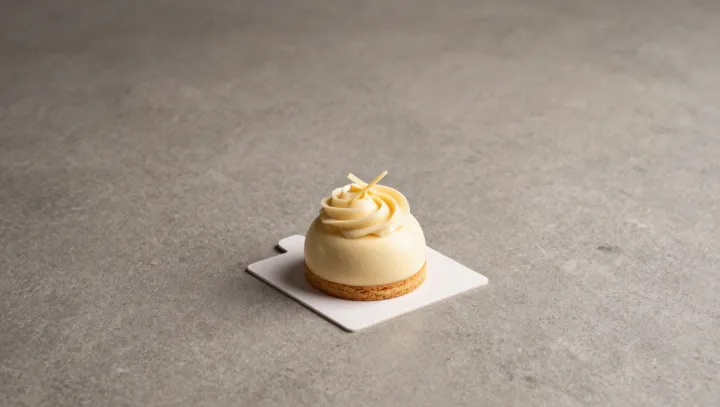
That tiny swirl is less decoration than engineering. On a plated mini dessert, whipped cream behaves like a soft solid because pastry chefs are quietly running a physics experiment on milk fat, water, and air. They time the chill, the shear from whisk or siphon, and the serving temperature so that a narrow band of fat crystals forms a scaffold before the structure can sag.
Air is the most underrated ingredient here. Each bubble is a load-bearing unit, but on its own it would vanish fast. Surrounding it is an emulsion matrix: partially coalesced fat globules forming a thin shell at the air–serum interface, a process driven by interfacial tension. As whipping introduces shear stress, globules collide, their membranes rupture in part, and they link into a three-dimensional network that pins the bubbles in place.
Temperature is the ruthless gatekeeper. Kept just above the melting point of milk fat, enough triglycerides sit in the solid phase to create a crystalline skeleton, while the remaining liquid fraction lets the cream flow through the piping tip. Drop the temperature too low and the network turns waxy; too high and fat melts, surface tension wins, and the swirl slumps. Stable rosettes exist in that narrow thermodynamic window, where fat crystallization, viscosity, and bubble pressure balance long enough for service.