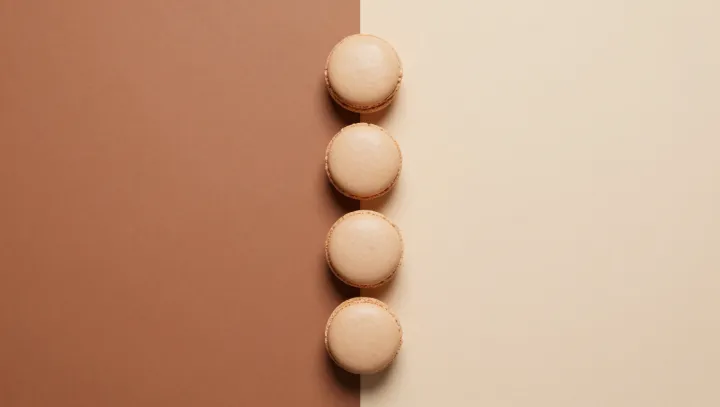
A macaron feels lighter not because it is innocent, but because physics is on its side. The glossy shell is a brittle crust that fractures under low mechanical stress, sending cracks racing across the surface and shattering the dome into small fragments instead of dense chunks. Each fracture exposes fresh interior, so saliva can flood in quickly and start dissolving sugar at many sites at once.
By contrast, a typical cookie behaves like a compact granular solid. Its fat, flour and sugar form a continuous matrix with fewer air cells and less porosity, so mastication must supply more force to break it down, keeping particles larger for longer and concentrating sweetness and fat on a smaller contact area of the tongue. That concentrated load reads as heavy.
Lightness here is really about surface area and trapped gas. The macaron’s meringue-based crumb is a foam, in the strict physical sense: a network of protein films surrounding innumerable microbubbles. When teeth compress this foam, air cells collapse and spring back, dispersing sugar and almond particles into a fine suspension that spreads across the mouth. The bite ends not with weight, but with rapid dissolution and fading resistance.