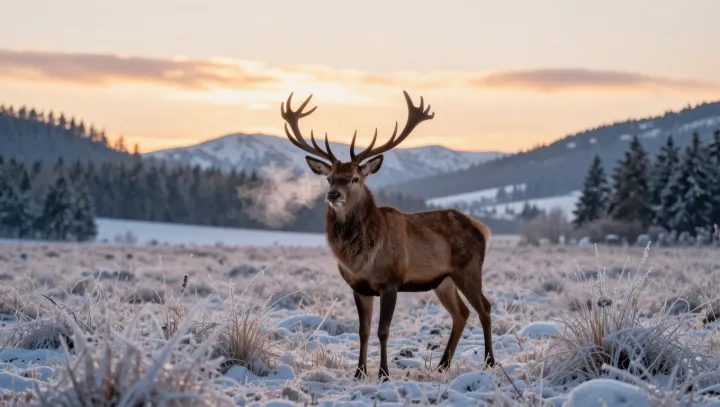
Cold, for a stag, is less an attack than a calculation. Around its body, fur acts as engineered insulation: long guard hairs form a wind-breaking shell while a dense undercoat traps air, turning each hollow hair shaft into a miniature thermos that slows conduction and convection from the skin to the snow-filled air.
More decisive still is what happens inside those still legs. Peripheral vasoconstriction tightens blood vessels in the skin and lower limbs, reducing warm blood flow to exposed areas so that core organs keep priority access to heat. In the limbs, countercurrent heat exchange lets warm arterial blood pass close to cooler venous blood, reclaiming heat on the way back to the torso instead of dumping it into the environment.
Immobility is not passivity; it is energy management. By standing still, the stag cuts mechanical work and preserves calories for basal metabolism, the continuous internal combustion that fuels heat production in liver and muscle. Brown adipose tissue and shivering thermogenesis can raise heat output when needed, yet the fur and vascular controls are so efficient that the animal often maintains core temperature without visible effort, a quiet victory in plain white exposure.