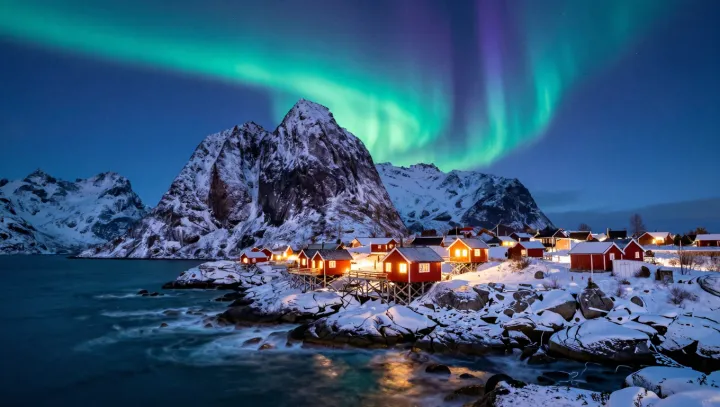
Darkness here is a technical problem, not a mood. Under a sky cold enough to lock the sea, a tiny Arctic fishing village stays lit by diesel generators that run almost without pause, feeding a microgrid buried in snow and foam insulation to keep copper lines from snapping in the cold.
Survival is engineered, not romantic. Fuel arrives by barge or ice‑class vessel when water is open, then sits in double‑walled tanks as a liquid bank account measured in kilowatt hours and fishing seasons, its combustion turning chemical energy into heat for homes and steady current for sodium lamps and LED arrays along the harbor. Waste heat from the engines is routed through heat exchangers and district pipes, so every watt squeezed from that imported fuel stretches one more night against the polar dark.
The sky, by contrast, spends nothing and steals the scene. Solar storms racing outward as streams of charged particles, known to physicists as the solar wind, meet Earth’s magnetosphere and are bent toward polar latitudes, where electrons slam into oxygen and nitrogen atoms in the upper atmosphere and trigger atomic excitation and photon emission that villagers simply call green curtains. While generators thrum at a fixed frequency to hold the grid at stable voltage, the aurora above flickers and folds with no regard for load forecasts, turning a working harbor into a temporary observatory every time the Sun remembers this outpost exists.