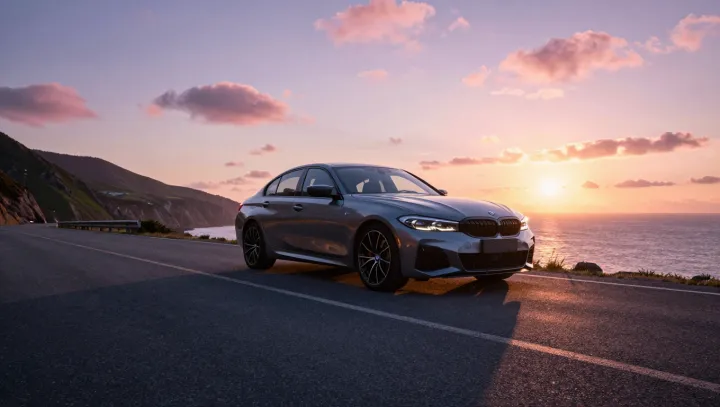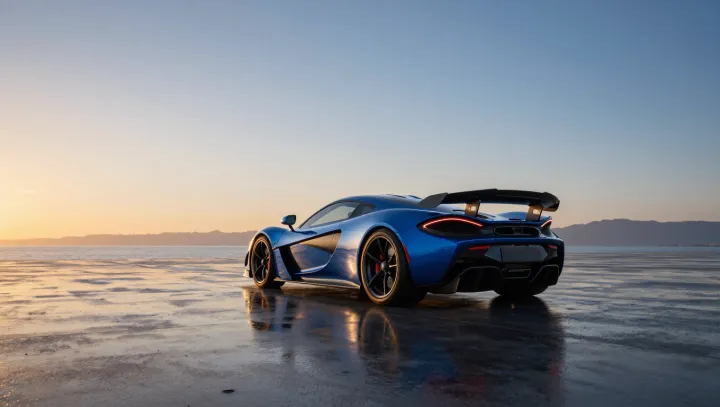
A bright blue supercar that turns almost black at sunset is not a design failure; it is a quiet indictment of human vision. Paint on these cars reflects short‑wavelength light, yet as the sun sinks, the spectrum shifts toward longer wavelengths and the blue channel in the scene is starved.
The real trick is that the eye does not simply dim; it switches operating modes. Cones handle color. Rods handle low light. Rods dominate. They are insensitive to blue, a phenomenon described by the Purkinje shift, and they compress subtle differences into a narrow gray scale that makes saturated blue paint collapse toward black on the retina.
The brain usually patches over this flaw with color constancy, a set of neural computations that reweight signals from the three cone types to keep familiar objects looking stable under changing illumination. At dusk that correction falters, because rod input overwhelms cone signals and the visual system prioritizes brightness over hue, misclassifying a reflective blue surface as simply dark.
Automotive designers quietly exploit this bias. High‑gloss clear coats and sharp body creases boost specular highlights, so a car can read as a sculpted black silhouette with a few razor lines of reflected sky, even when the underlying pigment is intensely blue.