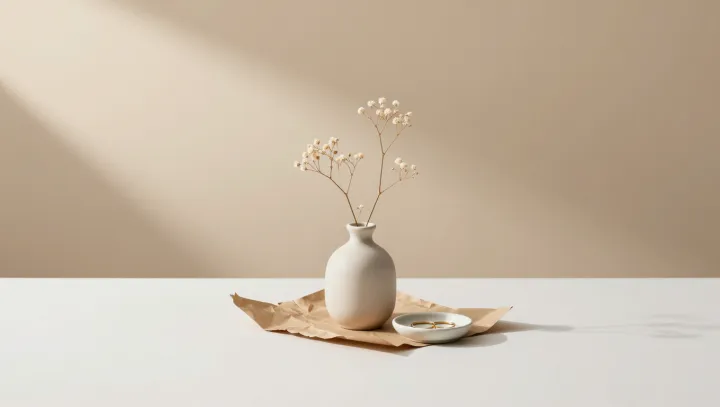
A glass with three pale freesia stems can quiet a viewer faster than a table smothered in blooms. That is not sentiment. It is perceptual economics. With few edges, low chroma, and a single focal axis, minimal still-life slashes what cognitive scientists call “visual load,” forcing fewer saccades and less working-memory recruitment than a dense, multi-hued bouquet.
Calm, in this context, is almost engineered. Narrow value contrast and restrained color keep the amygdala’s threat-detection circuitry under-stimulated, while the predictable vertical lines of stems in water offer what environmental psychologists describe as “soft fascination,” a gentle capture of attention that leaves executive function relatively idle. The clear vessel behaves like a visual negative space amplifier, extending the field of low information and giving the parasympathetic system room to dominate over arousal.
There is also a cultural overlay that tips the scales toward the spare image. Clinical interiors, wellness branding, and even interface design have trained viewers to read white space, translucency, and repetition as proxies for hygiene, control, and order. A lush bouquet, saturated and chaotic in its micro-geometry, may impress, but the thin stems in clear water invite something quieter: a pause that feels both controlled and mercifully empty.