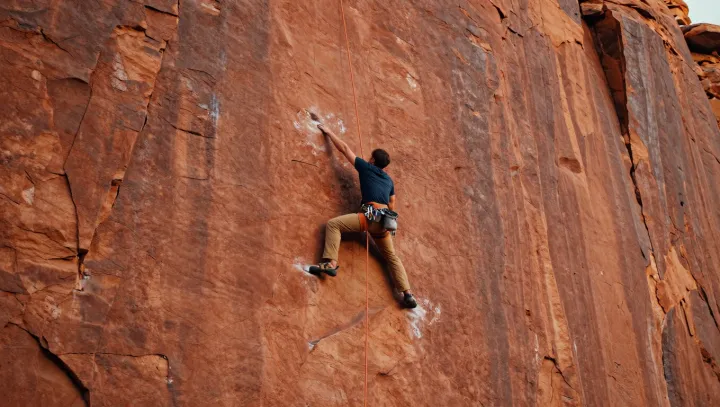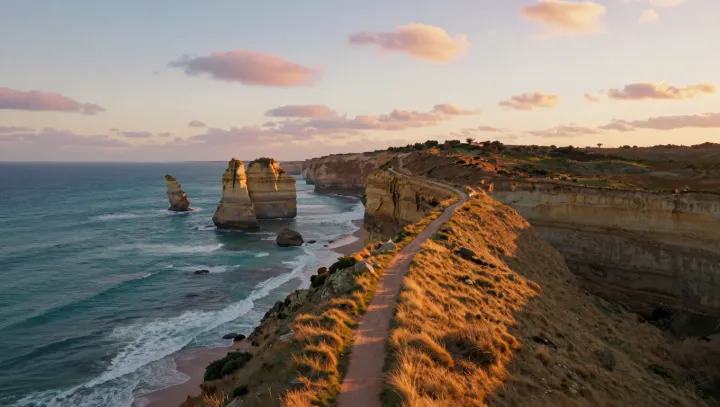
Golden-hour light lies. It flatters these vertical walls of rock as if they were permanent, even as that same raking angle exposes the truth in fine detail and uneasy color shifts along the base. Against the low sun, faint horizontal bands darken, thin ledges glow, and hairline cracks show up as sharp, ink-like strokes across the cliff face.
The harsher claim is this: chemistry, not crashing waves, is doing most of the quiet work. Seawater seeps into pores and fractures, where dissolution and ion exchange strip out calcium carbonate and feldspar, leaving weakened frameworks of grains. In the spray zone, halite and gypsum crystals grow and shrink with each tidal cycle, a textbook case of salt-weathering that wedges open microcavities far faster than mechanical abrasion alone.
Most deceptive of all is the cliff foot. Under the warm glow, subtle undercuts appear as narrow, darker scallops, classic signatures of differential solution in carbonate and cement-rich bands. Here, slightly more alkaline film water, loaded with bicarbonate ions and carbonic acid, eats away at joints and bedding planes, advancing inland like a hidden karst front. The photograph shows serenity; the chemistry writes an eviction notice for the rock.