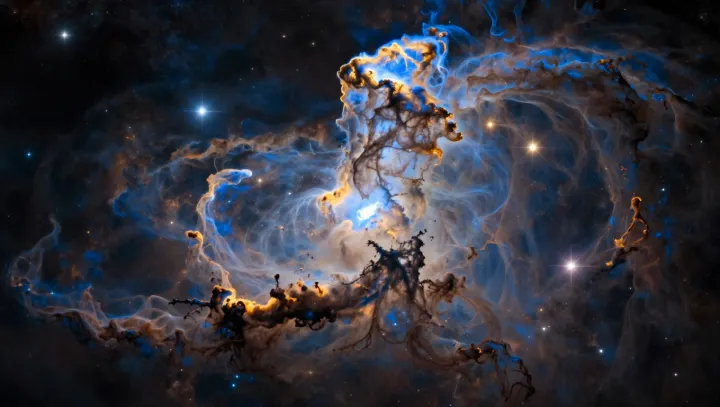
Cold darkness is not the enemy of fire here. Inside a bright emission nebula, those murky pillars are simply where the physics runs hottest below the surface, as ionized hydrogen glows outside while dense molecular gas stays shielded inside.
Star birth, in this view, is less a gentle unfolding than a forced collapse. Ultraviolet radiation from massive young stars scours the surrounding gas into an ionization front, compressing nearby clumps of molecular hydrogen and dust until self‑gravity wins, and a protostar forms at the core of a collapsing cloud that remains colder than ice by earthly standards.
The real trick is insulation. Dust grains block high‑energy photons, so the pillar interior can radiate away heat through infrared emission while still gaining mass, allowing gravity to drive densities high enough for nuclear fusion without the cloud evaporating, and magnetic fields thread these structures, slowing collapse just enough to regulate how quickly material feeds the forming star.
Only once fusion ignites does the contradiction resolve. A blazing young star carves cavities and jets through its cradle, punching holes in the same pillar that hid it, while the outer shell still looks dark in visible light, a silhouette that masks how violently bright the center has become.