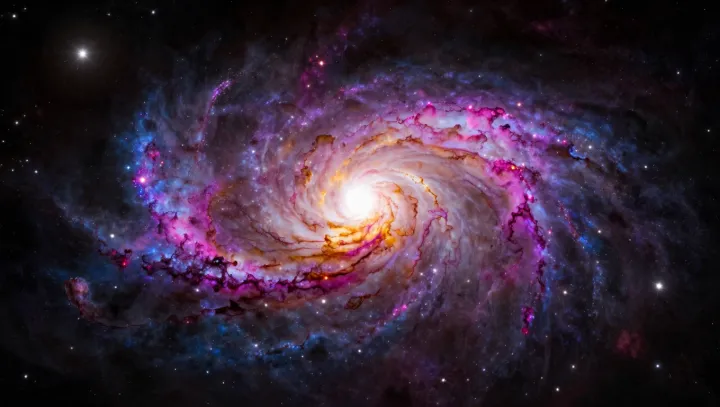
A golden spiral that seems tranquil on a telescope image is, in practice, a rotating traffic jam. Along each arm of a spiral galaxy, stars crowd into lanes where their orbital speeds and positions are regulated by gravity, not by direct impact, and this packed structure is what gives the pinwheel its sharp, photogenic form.
The odd truth is that congestion here almost never means collision. Stellar densities in a galactic disk are so low that, scaled to the size of a city, each star would sit farther from its neighbor than planets are from their suns, and classical N body dynamics shows that mutual gravitational tugs bend orbits far more often than they produce head on crashes.
What looks like a rigid pinwheel is instead a pattern wave. Spiral density wave theory holds that the bright arms behave like slow moving zones of compressed material, where interstellar gas is squeezed, star formation ignites, and older stars drift in and out, much as cars enter and leave a highway bottleneck while the jam itself appears almost fixed in place.
The deeper claim is that order here is statistical, not individual. Angular momentum conservation keeps stars circling the galactic center in stable orbits, while differential rotation shears the disk so that the outer regions lag, the inner regions race ahead, and the whole system maintains its pinwheel outline without needing stars to touch even once.