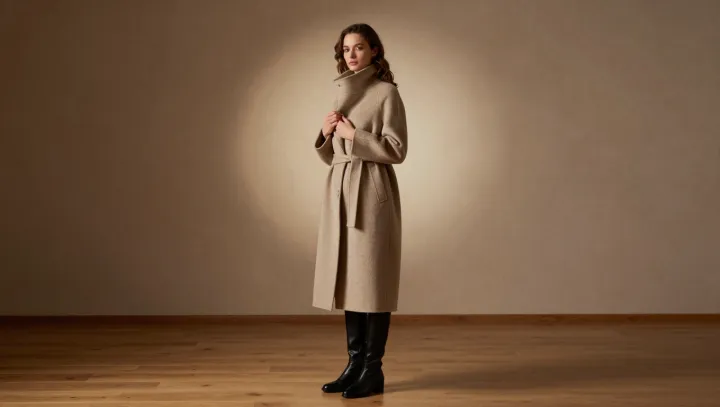
A sharply cinched waist can speak faster than any biography. Before a stranger registers eye color, the brain has already run a silent risk assessment, drawing on thin-slicing and visual heuristics stored in long-term memory. Clean vertical lines, precise shoulders, and a defined belt echo uniforms and executive tailoring, patterns repeatedly linked with status and competence in social cognition research.
Authority here is not a vibe; it is a shortcut. In the first split seconds, the fusiform gyrus and visual cortex process silhouette and contrast, while the amygdala and prefrontal cortex coordinate a rapid trust calculation, long before reflective reasoning joins the scene. Studies on person perception show that structured outerwear is grouped with formal business dress, which reliably boosts attributions of leadership, intelligence, and even moral reliability.
Trustworthiness, too, is quietly manufactured in fabric. A belted long coat frames the torso into a stable, symmetrical column, dampening visual noise that might signal unpredictability. That symmetry taps into deep-seated preferences shaped by evolutionary psychology and schema theory, so the wearer is filed under predictable, self-controlled, safe. A degree or title may live on paper; the coat broadcasts its own credential in real time.