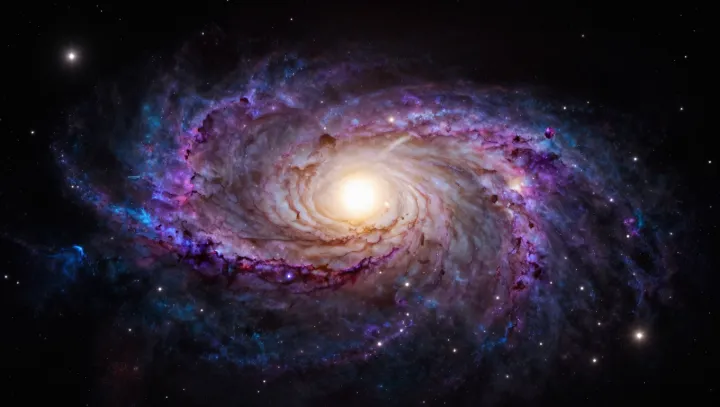
Gravity, in this case, is almost cheating. A spiral galaxy stretches across hundreds of thousands of light years, yet its visible stars provide only a fraction of the mass needed to keep those whirling disks from flying apart under observed rotation curves. Flat rotation profiles, revealed by radio measurements of neutral hydrogen, show that orbital speeds stay high far beyond the bright stellar disk, defying expectations from luminous matter alone.
Central to that quiet trick is the dark matter halo. It extends far beyond the starlit spiral, a roughly spherical reservoir whose mass dominates the baryonic component and deepens the gravitational potential well that binds gas, dust and stars. Within this potential, density wave theory explains why arms persist: spiral patterns are not rigid structures of fixed stars, but long‑lived waves in the stellar disk, slightly compressing gas and triggering star formation as material orbits through them.
So the elegance is not fragile at all. The halo stabilizes the disk against violent instabilities, sets the circular velocity profile and provides the background field in which differential rotation and self‑gravity cooperate to maintain spiral density waves. What looks like a delicate swirl of starlight is, in practice, the visible frosting on a massive, invisible scaffold of dark matter.