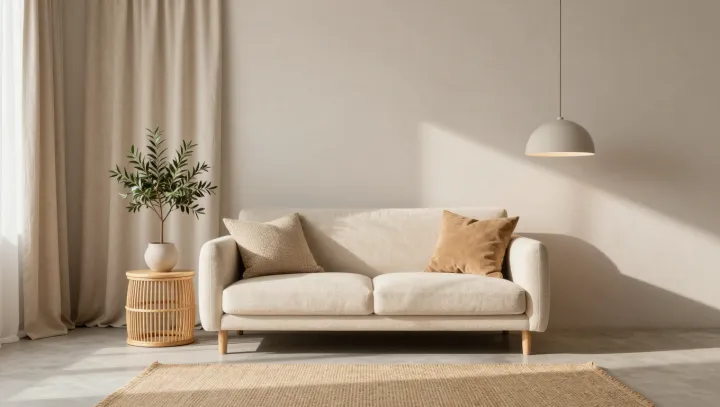
Beige walls do more work than the brightest lamp. Against a low-contrast backdrop, the eye’s edge detectors in the retina and primary visual cortex receive fewer abrupt luminance and color changes, so the entire visual system runs at a lower baseline load while you read.
Harsh decor, by contrast, acts like visual static. Every black frame on a white wall, every saturated pillow against a dark sofa, creates high spatial frequency edges that repeatedly trigger lateral inhibition and contrast gain control in retinal ganglion cells. Those micro-transitions demand constant saccades and refocusing, so the ciliary muscles and extraocular muscles stay in near-continuous adjustment, a known pathway to subjective visual fatigue and headaches during sustained reading.
A warm, low-contrast beige nook quietly removes these triggers. Surfaces sit closer together in luminance and chroma, which lowers edge density across the visual field and reduces the need for continuous micro-corrections in accommodation and vergence. Studies in visual ergonomics show that such environments reduce blink suppression, stabilize fixation, and keep cortical arousal closer to resting levels. The page, not the room, becomes the only high-value signal the brain needs to track.