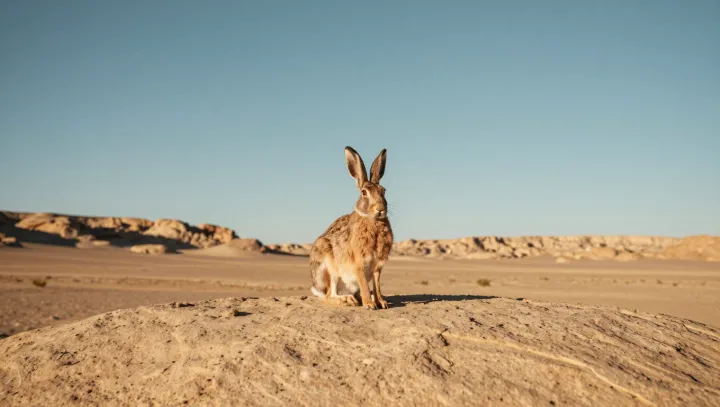
Bare rock makes the hare look exposed, yet the real trap is for the predator. Against a sun-bleached slab, a desert hare that locks every muscle and flattens its ears stops feeding the brain’s favorite signal: motion. Many carnivores rely on motion-sensitive retinal ganglion cells and edge-detection circuits that light up when something moves or changes contrast across the visual field.
Stillness wins here. Predators often sweep terrain with quick eye movements, tuned to detect parallax shifts, tiny hops, or ear flicks. When the hare freezes, its outline merges with rock shadows and surface cracks, and those detection algorithms in the visual cortex receive almost no temporal cue. Heat plays another trick: intense solar radiation and ground temperature generate shimmering air, a refractive effect known as atmospheric scintillation, which blurs fine contours at a distance and degrades spatial resolution.
Color is overrated in this scene. Many desert hunters, including canids and raptors, have limited chromatic sensitivity and lean on luminance contrast rather than hue. A hare whose fur matches the average brightness of rock and sand becomes a low-contrast patch, especially when no limb or whisker twitches to refresh its position on the predator’s internal map. The rock looks empty. The hare is still there.