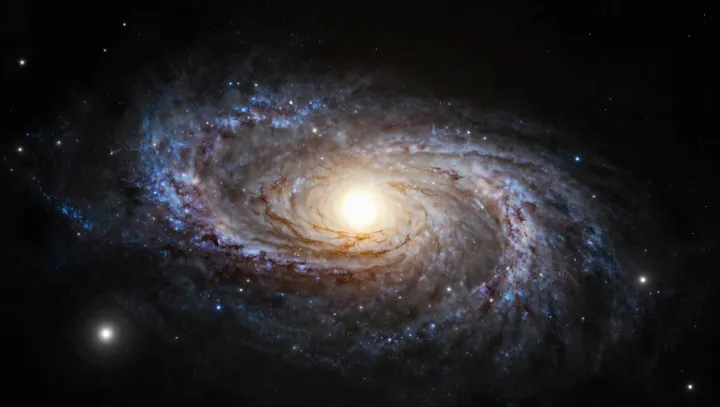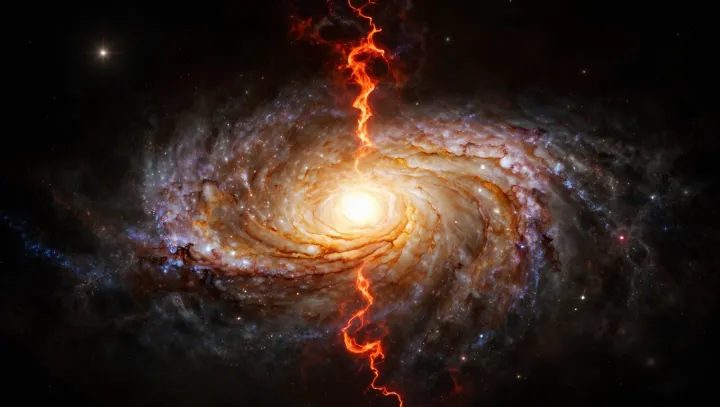
Calm is a lie at a spiral galaxy’s center. Around the supermassive black hole, gas whirls in an accretion disk and launches jets that act like a hidden governor on the entire stellar system. Though the core may look quiet in visible light, high-energy radiation there heats and expels gas that would otherwise cool into new stars across the disk.
Power flows outward, not through direct tug on each star, but through gravity sculpting the galaxy’s potential well. The black hole’s mass anchors the inner rotation curve, locks the central bulge into a dense configuration, and indirectly shapes bar structures that redistribute angular momentum. Those bars herd gas inward, feed the core again, and trigger bursts of feedback that quench or ignite star formation tens of thousands of light-years away.
Subtler still is its long game. By tying its growth to the stellar bulge through the M–sigma relation, the black hole couples to the surrounding dark matter halo that sets the galaxy’s orbit in a group or cluster. That mass budget helps determine whether two spirals spiral closer, how violently they merge, and how their stars are flung into new trajectories when a future collision remakes the sky.