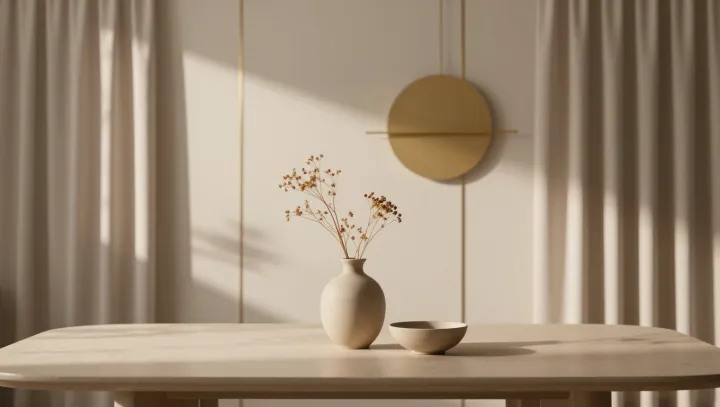
A $20 stone-textured vase can do what contractors promise but walls resist. It makes a tight room feel wider, quieter, almost exhaled. Not by magic, but by hacking how the visual cortex weights depth cues and clutter. The rough ceramic surface creates micro-shadows that exaggerate edge contrast, a form of local luminance gradient that helps the brain infer a foreground anchor.
That anchor matters more than most floor plans. Once the brain locks onto a clear near object, it stretches the apparent distance to the next major boundary, a classic figure–ground and perspective shortcut. A few tall dried stems then act as vertical parallax markers: as you shift position, their relative motion against the back wall feeds motion parallax and size constancy circuits, which register extra depth that does not exist in the blueprint.
Even bolder is what the wall lines do. Simple geometric lines reduce visual entropy, so the scene demands less saccadic eye movement and less working memory load. Fewer competing objects mean lower perceived clutter and lower amygdala arousal, while the remaining lines give the dorsal stream clean, continuous contours to track. The result feels like someone pushed the walls outward, when in fact only a cheap vase and a few lines changed the brain’s model of the room.