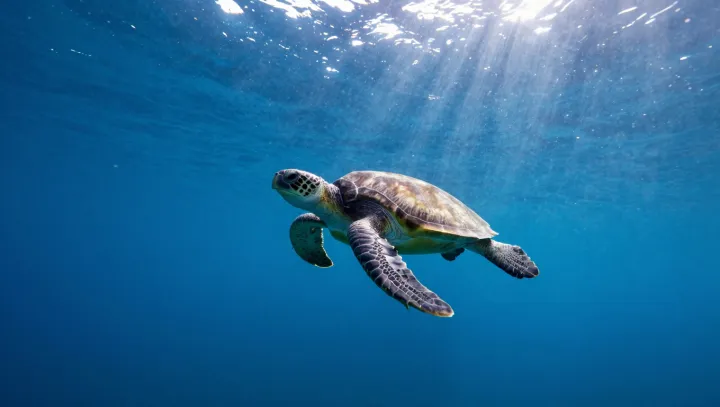
A rigid shell should have been an evolutionary dead end for ocean travel. Yet sea turtles turned that armored box into a long-range chassis, not by swapping lungs for gills, but by rewriting the way their limbs push against water. Their story is less about new organs, more about extreme retooling of old hardware.
The key move is simple to say, brutal to engineer. Turn legs into wings. Inside each flipper, the humerus, radius, and ulna are stretched and flattened, while wrist bones lock into a stiff hydrofoil that resists bending but slices water. Large pectoral muscles anchor to the fused ribs of the shell, turning the torso into a stable mounting plate that lets each stroke act like an efficient downbeat in a lift-generating stroke cycle.
Breathing, oddly, barely changed. Sea turtles kept the basic reptile lung, lodged under that immovable shell, and worked around it. Instead of expanding a flexible chest, they use abdominal muscles and limb-driven pressure changes to ventilate the lungs, separating propulsion from respiration so a turtle can glide between strokes without collapsing its air supply.
What looks like serene drifting is hard biomechanics. A long, winglike foreflipper handles thrust and partial lift, while shorter hind flippers provide trim control and steering, a division of labor that cuts energy costs across enormous distances. Evolution did not scrap the land reptile blueprint; it squeezed new performance out of the same bones and the same air-filled core, until a beach crawler became an ocean commuter.