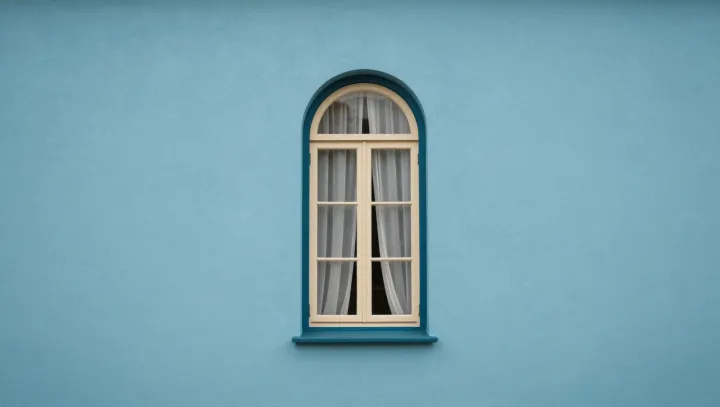
Light takes the lead. As it enters through an arched opening, its curved boundary sets a dominant visual hierarchy, while the curtain interrupts the field with an edge that changes shape, density, and position. The wall is not empty. It becomes a measured ground against which luminance contrast can register.
Ornament often loses. A richly decorated facade distributes attention across competing motifs, so the eye scans without finding a clear anchor; cognitive load rises as contour after contour requests equal status. The arch refuses that bargain. Its single silhouette exploits Gestalt grouping, making the opening read as one stable figure, while the curtain introduces controlled occlusion and a small uncertainty. This is perceptual economy, not minimalism as a fashion signal: fewer cues receive more room to establish rank, scale, and expectation.
Absence does more work. Turquoise supplies chromatic contrast against pale light, and moving fabric adds temporal variation, allowing the scene to change without adding objects. The effect sharpens when daylight shifts, because a fixed color field makes each slight alteration legible. Decoration can announce wealth. Restraint announces attention. In the held curve of the window, a wall becomes less a surface than a pause with weather passing through it.