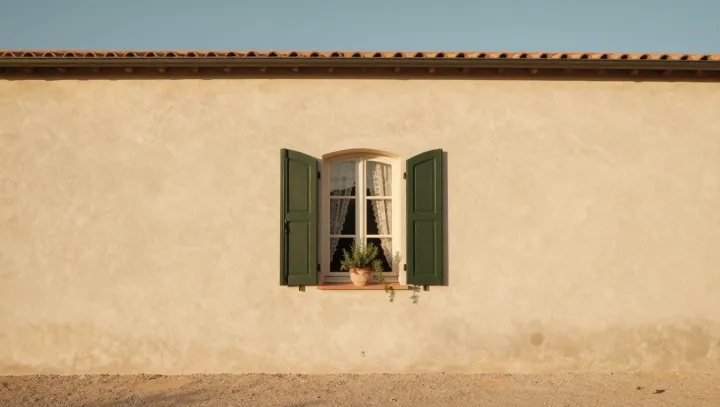
Light catches the curved reveal before it reaches the glass, and a flat stucco wall seems to pull back from the street. The effect holds. The arch turns a thin opening into a measured pocket of shade, making surface and void read as separate planes.
That is the real advantage. A curved head distributes the eye's attention along a continuous contour, rather than stopping it at two sharp corners; the gaze follows the arc inward, then returns across the wall. In perceptual terms, the opening gains depth cues through occlusion and a luminance gradient. Even shallow reveals produce a penumbra, the soft-edged shadow that makes plaster appear thicker than it is. The aperture also appears taller without demanding a larger pane. This is proportion, not illusion.
Comfort begins with ambiguity. The curve refuses the hard verdict of a rectangle: it suggests enclosure without sealing the facade, while its radial geometry lets light slide gradually across the jambs. Corners declare a boundary. An arch instead gives the eye a gentler route, so a wall built from mortar, sand, and lime can borrow the hush of a recess. Stucco helps because its grain scatters light instead of returning one clean reflection; small irregularities keep the transition from brightness to shadow alive. At dusk, its shadow becomes the wall's quiet second skin.