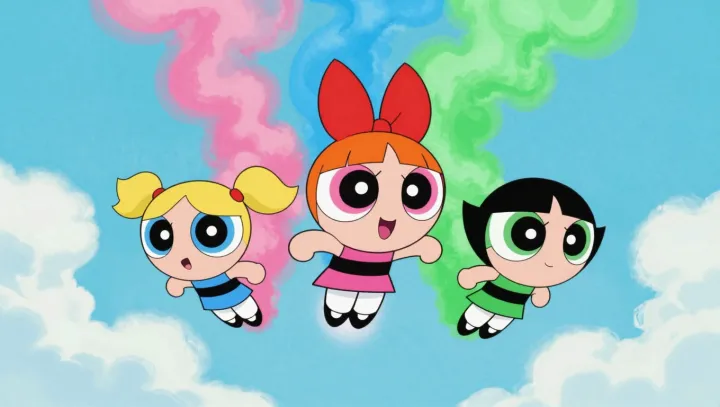
Three giant circles win. Before a punch lands or a line is spoken, the heads of Blossom, Bubbles, and Buttercup fill the frame, while dot eyes and a small mouth lock each face into a readable signal. You do not need fluid motion to identify them. Their geometry reaches you first.
That is not laziness. The show treats character design as Gestalt grouping: viewers assemble circles, stripes, hair blocks, and eye placement into a whole before they inspect detail. In peripheral vision, silhouette recognition favors large contrasts and stable proportions, so each girl remains legible when frames are held, reused, or viewed at a glance. You get identity cheaply. Blossom's bow and red stripe suggest command; Bubbles' pigtails and blue code softness; Buttercup's black hair shape and green band broadcast friction. No eyelashes needed.
The trick is almost rude. Traditional animation can sell personality through pose-to-pose acting, yet this design puts the burden on a visual checksum: remove most information, retain the cues that your visual cortex ranks first. You see a face, then a faction, then an attitude. That order turns simple assets into an icon system, and it lets a frozen cel carry nearly the same brand signal as motion. Would you remember them as fast if every feature were rendered?