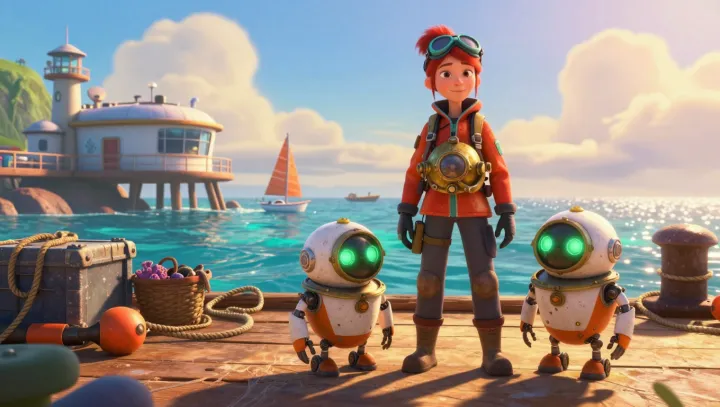
The harbor is already moving. Sunlight lies flat on the water, while chipped masks, hoses, and metal joints wait at the pier, making stillness read less as safety than as a paused operation. Before a boat leaves, the scene supplies an unfinished brief: something is below, equipment has a purpose, and action has been delayed rather than canceled.
That is not mere romance. Predictive coding gives the brain a working guess about what comes next, then compares sensory input against that guess through prediction error. Rust does useful work. Visible wear implies prior use and unresolved risk, so the salience network may treat battered gear as evidence of consequence rather than decoration. Robots tighten the script. An articulated machine aimed at a task suggests goals, constraints, and hidden data; it makes the quay feel like a control room with a job pending.
The harbor sells anticipation. Like a game engine loading assets before the player gets control, hippocampal pattern completion can assemble scattered cues into a likely episode: descent, search, recovery. The payoff arrives early. Designers of waterfront exhibits, films, and games can leverage that effect by pairing bright visibility with instruments that signal labor, danger, or access to an unseen zone. As autonomous machines become common, a quiet dock and a machine with intent may start the story inside the nervous system.